
What does digital transformation mean for government teams?
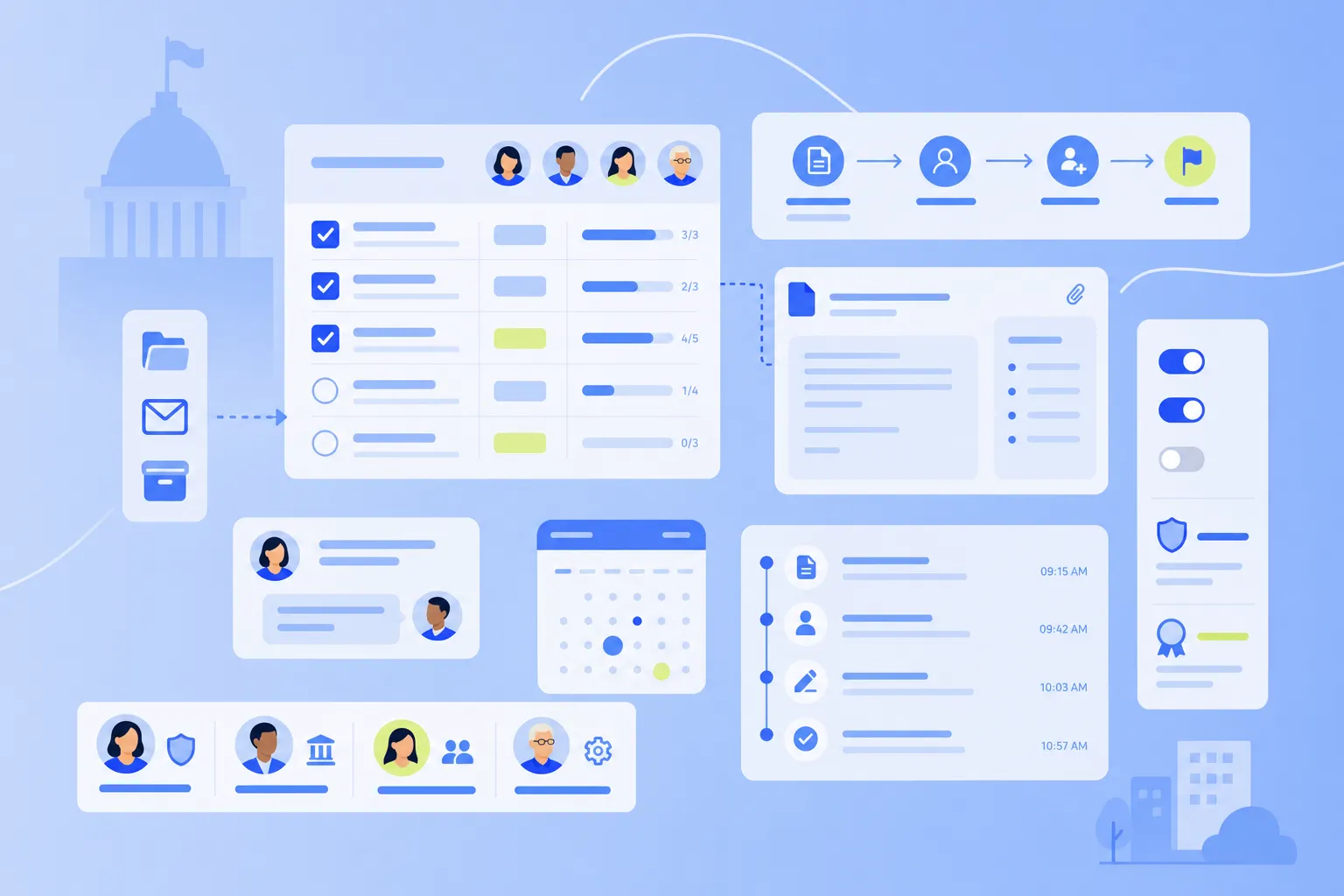
Digital transformation in the public sector is the process of replacing paper-based, email-driven and analog workflows with structured digital systems that make work visible, assignable and trackable.
It is an operational change in how every department coordinates, documents and completes work each day.
That distinction matters. When people hear "digital transformation," they often picture citizen-facing portals and online forms. Those services are important, but the harder, less visible work is internal: the approvals, hand-offs and documentation that keep an authority running. This article focuses on that internal side and on the knowledge that holds it together.
There is usually a wide gap between the intention to digitize and the daily reality. Many public authorities agree that digital tools would help, yet still run core processes on paper and in email. As the OECD notes, achieving a coherent, government-wide digital transformation takes clear governance and leadership, not just new software. It is a shift in culture, methods and processes, supported by the right tools rather than defined by them.
Which processes should government teams digitize first?
Most government departments start their digital transformation with five operational processes: internal approvals, cross-department coordination, staff onboarding, compliance documentation and online citizen-service digitization. Starting with these five delivers visible results within weeks rather than months, which builds the confidence a wider rollout needs. Because these are everyday processes, success also depends on managing the change that comes with new tools, not just installing them.
1. Internal approvals
Before: paper forms circulate from desk to desk, and no one can say where a request is sitting or who is holding it up. After: the approval becomes a workflow in MeisterTask, with automations that assign each step to the right person and a timestamped history that shows exactly where the request stands.
2. Cross-department coordination
Before: work between offices happens in long email chains, and important context gets buried or lost when someone is out. After: a shared MeisterTask board gives every department involved the same live view of tasks, owners and status. That is how Südwestfalen-IT, a regional IT provider serving more than 70 municipalities, coordinates work across authorities, in one place instead of dozens of inboxes.
3. Staff onboarding
Before: a paper checklist walks each new starter through their first weeks, and departments forget steps or complete them out of order. After: an onboarding project holds department-specific sections and automatic reminders, so every new colleague follows the same complete path, no matter which office they join.
4. Compliance documentation
Before: policies and procedures sit in shared drives that nobody searches, so staff fall back on asking a colleague. After: the documents live in the Notes feature, linked directly to the task boards where the work happens, so the current version is always one click from the task it governs.
5. Online citizen-service digitization
Before: teams track the rollout of each digital service manually, and progress is hard to see across services. After: each service becomes a project with milestones and named owners. In Germany, this is the work behind the Online Access Act (OZG), which requires authorities to offer administrative services online, and framing each service as a project keeps its progress transparent.
MeisterTask supports each of these because boards, assignments and a task history are built in. That lets a team start with a single process and expand from there, instead of waiting for a large IT rollout. A sensible first step is to pick the process that causes the most follow-up emails today, map it onto one board and run it that way for a month before adding the next one.
Why do most government digitalization projects stall?
Most government digital transformation projects stall for three reasons: the tool is too complex for staff who have worked on paper for decades, no single accountable person owns the project and successful pilots never scale beyond the department that ran them. These are among the common barriers to digital transformation, and they often appear together.
A fourth reason is specific to the public sector: data-protection anxiety. When staff fear making a mistake with citizen data, the safest-feeling option is to do nothing, and the project quietly stops. The answer is not more caution but clearer rules, a tool with compliance built in and visible permission to proceed.
Scaling is where most authorities lose ground. A pilot succeeds in one office, then never spreads because nobody is responsible for the rollout. The Arnsberg District Government solved this by scaling through internal champions it called "digital first responders": staff who already knew the new way of working and helped their colleagues adopt it. Naming an accountable owner and equipping a few champions simultaneously addresses ownership and scaling problems.
Why does knowledge management matter more in the public sector?
Public sector organizations face a knowledge-management crisis that most private companies do not. Experienced staff are retiring at scale, taking decades of institutional knowledge about processes, regulations, and stakeholder relationships with them. Unlike private companies that can hire replacements with equivalent experience from competitors, government departments lose knowledge that exists nowhere else.
The numbers show how close this is. In a 2025 MissionSquare workforce survey of US state and local government employers, 46% said the most significant wave of retirements is still to come, yet 61% reported having no succession planning process in place. That combination is what turns an ordinary retirement into an operational risk.
The danger is not only losing expertise. It is losing the ability to run processes that only one person fully understood. This connects directly back to digital transformation: if you digitize a workflow without capturing the knowledge behind it, you create a digital process that nobody understands well enough to fix when it breaks.
What does institutional knowledge look like in a public authority?
Institutional knowledge in government falls into three categories. Process knowledge is how things are actually done, which is often different from how they are documented. Regulatory knowledge is which rules apply in which situations and how they interact. Relationship knowledge is who to call, who makes decisions and which stakeholders need to be involved and when.
A concrete example makes the risk clear. A caseworker who has processed building-permit applications for 25 years knows which offices to consult in which order, which regulations interact and which stakeholders to bring in early. When that person retires, the successor inherits the regulations but not the applied knowledge of how to use them. The result is delays, avoidable errors and frustrated residents, all because the practical layer of knowledge was never written down.
How can government teams capture and preserve institutional knowledge?
The most effective way to capture institutional knowledge in government is to document it where the work happens. Not in a separate knowledge-management system that nobody updates, but embedded in the workflows, task boards and process documentation the team already uses every day. Four practices make this routine.
1. Document processes as they are really done
Write down the real steps, including the workarounds and exceptions, rather than the tidy version in the official procedure manual. Use the Notes feature to keep living process documents that the team updates as the process changes, so the record stays true to practice.
2. Capture decision rationale on tasks
Every task comment in MeisterTask is timestamped and attributed to a person. When a decision is made, record why in the task comment rather than in a private email. Over time, this builds a searchable decision log that answers the question new staff ask most: why do we do it this way?
3. Build onboarding knowledge into project templates
When someone joins, the knowledge they need should sit in the task descriptions and checklists they work through, not in a binder nobody opens. Turning a completed onboarding into a reusable project template means that each new colleague automatically inherits the same institutional knowledge.
4. Schedule knowledge transfer before departures
Create a recurring task three to six months before a planned retirement, assigning it to both the departing and incoming staff members. Pair it with structured lessons-learned sessions so the hand-off becomes a deliberate process with a clear owner rather than a last-minute scramble.
How do knowledge management and digital transformation depend on each other?
Digital transformation without knowledge management creates digital processes that nobody understands. Knowledge management without digital transformation creates documented knowledge that nobody can find. The two are only effective together: digital workflows make knowledge actionable, and captured knowledge makes digital workflows sustainable over time.
In practice, the connection is that the boards and the Notes feature are one workspace, not two systems. A process documented in Notes links to the board where that process runs. When the process changes, the documentation updates in the same place. When a new colleague joins, they see both the tasks and the knowledge behind them, so the workflow and the reasoning stay together instead of drifting apart.
How does MeisterTask support public sector digital transformation?
MeisterTask provides the coordination layer, including task boards, automations and cross-department visibility, while its Notes feature provides the knowledge layer, including process documentation, decision logs and onboarding materials. Both live in a single workspace, so the knowledge sits alongside the work it supports rather than in a separate archive.
Five use cases show how this works in a public authority:
Approval workflows run on automations and recurring tasks, so routine sign-offs no longer depend on someone remembering to forward an email.
Cross-department project boards give every office involved a shared view, the kind of transparent exchange across departments that the Arnsberg District Government describes.
Process documentation lives as standard operating procedures in the Notes feature, linked to the boards where the work happens.
Knowledge transfer runs through onboarding templates that carry institutional knowledge to each new colleague.
A compliance trail records every action with a timestamp and an owner, so the authority can show what happened and when.
Where citizen and staff data is involved, the details matter. MeisterTask is ISO 27001 certified, GDPR compliant and hosted in an ISO 27001-certified data center in Germany, so a public authority can adopt it without compromising on privacy or accountability.
Bringing digital transformation and knowledge management together
The lesson for government teams is that digitizing the work and preserving the knowledge behind it are not two projects but one. Digitize a workflow and you make the work visible and assignable. Capture the knowledge that drives it and you make that workflow sustainable when the people who built it move on.
MeisterTask brings both into a single secure space, where organized boards, transparent progress and connected documentation sit alongside the compliance a public authority needs. To see how it fits your teams, explore MeisterTask for public authorities, start with one process and let the workspace grow with the way your teams work.