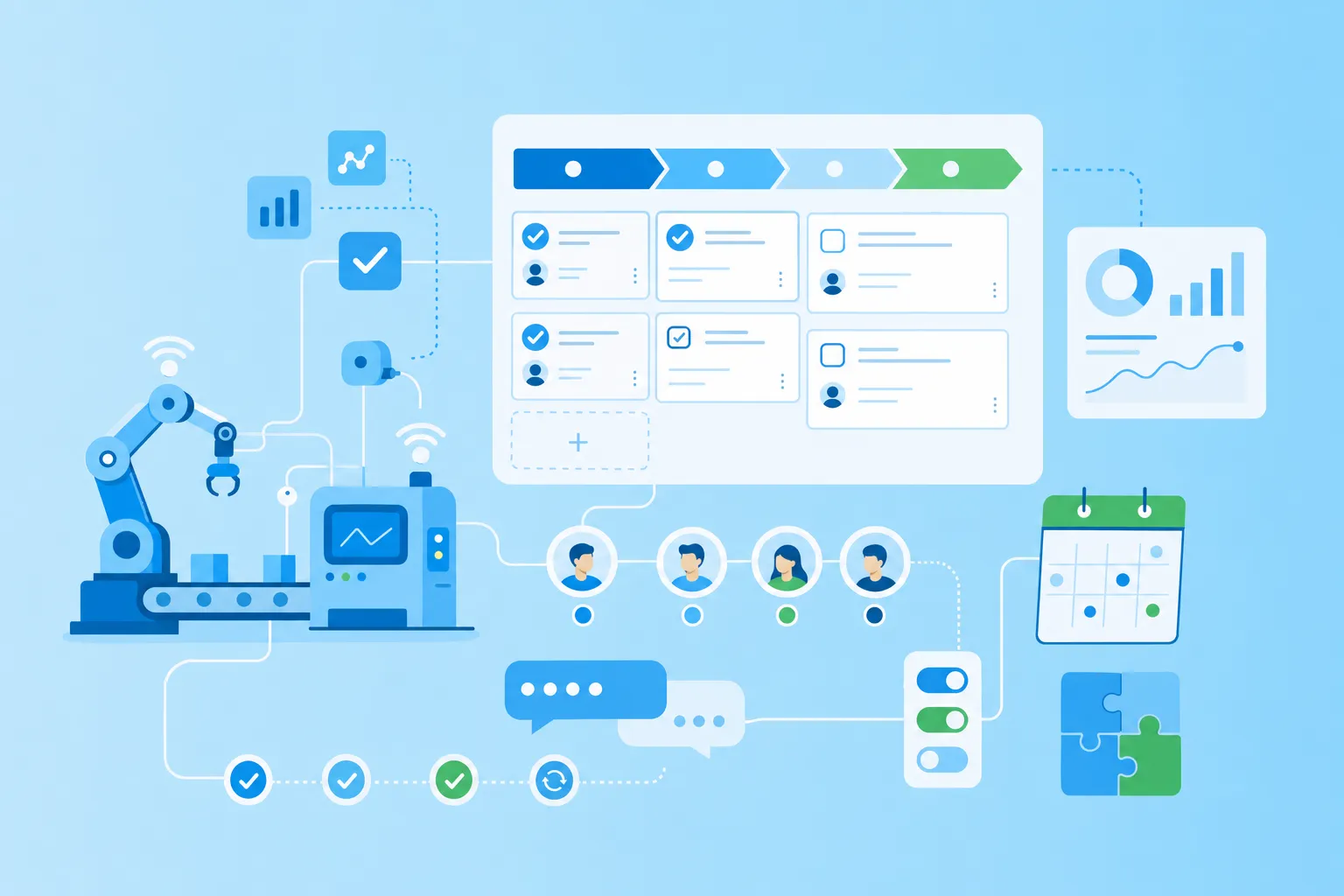


Understanding IoT in manufacturing
IoT in manufacturing means connecting sensors and devices to gather real-time data from your production equipment, machines and systems across the factory floor. Think of it as giving your machines the ability to report their status, performance and problems automatically.
The Industrial Internet of Things (IIoT) is the manufacturing-specific version of IoT technology. While consumer IoT focuses on smart homes and wearable devices, IIoT prioritizes the reliability and real-time performance that production environments demand.
According to NIST SP 800-183, IoT systems perform four core functions:
Sensing: Collecting data from the physical world through sensors
Computing: Processing that information to identify patterns or problems
Communication: Transmitting data across networks to other systems
Actuation: Taking action based on the processed information
In a manufacturing context, this might look like temperature sensors monitoring equipment heat levels (sensing), edge computers calculating when maintenance is needed (computing), industrial networks sending alerts to technicians (communication), and controllers automatically adjusting machine settings (actuation).
What makes IoT different from traditional manufacturing systems? Connection. Instead of machines operating in isolation, IoT links equipment across your entire production environment. You gain visibility into operations that used to require manual checks and clipboard rounds.
How IoT manufacturing boosts efficiency
IIoT solutions give you real-time visibility into operations, helping your team spot issues faster and make better decisions. Rather than waiting for hourly reports or discovering problems during quality checks, you see what's happening right now.
The operational benefits change how manufacturing teams work every day:
Real-time visibility: connected sensors display current machine status, production rates and quality metrics on dashboards that update continuously
Faster problem detection: IoT systems alert you when equipment temperatures rise above normal or production speeds drop below targets
Better resource allocation: capacity planning helps you know which machines have spare capacity and which operators face bottlenecks.
Reduced manual monitoring: automated data collection eliminates those hourly clipboard rounds, freeing your staff for higher-value work
Here's what this looks like in practice. A packaging line sensor detects that a sealing unit runs 15% slower than normal. The system sends an alert before products start backing up. Or temperature monitors in an injection molding machine warn operators about overheating before it causes defects. These IoT use cases in manufacturing help teams complete more orders in the same timeframe while reducing the stress of constant firefighting.
Key challenges of IoT integration in factories
While IoT offers clear benefits, you'll face real obstacles during implementation. Understanding these challenges helps you prepare for success rather than discovering problems after investing in new technology.
Manufacturing teams typically encounter five main hurdles:
Connecting legacy equipment: This can be especially challenging for machine manufacturers because older machines weren't built for connectivity. They often require retrofit sensors, protocol converters or gateway devices to communicate with modern systems.
Data security concerns:
The ISA/IEC 62443 standards provide a framework for securing industrial control systems, but you'll need to build security into your implementation from day one.
Integration complexity: Different equipment speaks different languages. While standards like OPC UA help systems communicate, connecting various protocols and data formats remains challenging.
Avoiding data overload: Collecting every possible data point creates confusion. Focus on metrics that drive specific improvements rather than drowning in information.
Scaling across facilities: Your successful pilot project on one line might not translate smoothly to plant-wide deployment.
Each challenge has practical solutions. Start with high-impact equipment rather than attempting full factory connectivity at once. Choose systems that support industrial standards to avoid vendor lock-in. The NIST IR 8228 guidance emphasizes managing IoT device risks across their entire lifecycle — from deployment through retirement.
5 ways IoT transforms production
Connected manufacturing changes how teams work in specific, measurable ways. These five transformations show the practical impact of IoT on your daily production operations.
1. Real-time machine insights for better decisions
IoT sensors continuously monitor machine performance, giving you instant access to production data. What exactly gets tracked? Cycle times, output rates, operating temperatures, energy consumption and error rates all flow into your dashboards.
This continuous monitoring replaces periodic manual checks. A production manager checks real-time data to reassign work based on actual machine capacity. A shift supervisor identifies which line runs behind schedule before delays cascade. Manufacturing intelligence software with IoT sensor support turns raw data into clear insights that drive smarter choices.
2. Predictive maintenance for fewer delays
Predictive maintenance uses sensor data to identify equipment problems before breakdowns occur. Unlike reactive maintenance (fixing things after they break) or scheduled maintenance (servicing equipment on fixed intervals), predictive approaches base actions on actual equipment condition.
Vibration sensors detect bearing wear patterns weeks before failure. Temperature monitors identify motor overheating early. Pressure sensors reveal seal degradation before leaks develop. Your team schedules replacements during planned downtime rather than scrambling during production runs. The result? Fewer emergency repairs and more predictable maintenance schedules.
3. Connected workflows for smooth collaboration
IoT data flows into work management systems, helping teams coordinate tasks based on real production conditions. When sensors detect issues, they trigger task assignments and workflow updates automatically.
Here's how machine usage data informs your production planning:
IoT sensors track which machines are in use, idle or under maintenance
Real-time availability data feeds into production planning systems
Teams assign new tasks to available equipment rather than guessing capacity
When machines complete jobs faster or slower than expected, planners adjust downstream schedules
Work management platforms like MeisterTask can centralize these connected workflows, letting production teams see both task status and equipment status together. Automated triggers keep everything moving:
Machine completes batch → system assigns quality check task
Sensor detects maintenance need → system creates ticket and notifies technician
Production line reaches capacity → system alerts supervisor to reassign work
4. Scheduling optimization with IoT data
Traditional scheduling relies on estimates about machine availability and cycle times. IoT changes this by providing actual performance data. You discover that a particular machine consistently takes 12 minutes per unit, not the estimated 10 minutes. This insight creates realistic schedules your team can actually achieve.
Dynamic adjustments happen when IoT data shows production running ahead or behind plan. You hit delivery deadlines more consistently and avoid overpromising to customers. Smart manufacturing using IoT turns scheduling from guesswork into data-driven planning.
5. Streamlined quality control and compliance
IoT sensors automatically track quality parameters during production — temperatures, pressures, dimensions and material properties all get logged without manual intervention. This creates automatic documentation for compliance requirements, particularly valuable in regulated industries.
Consider these examples:
Temperature logs for pharmaceutical production
Traceability data for automotive parts
Process documentation for food safety
Automated monitoring catches deviations immediately, not during post-production inspection. You get less rework, fewer defective products and easier audit preparation. The ISO 23247-1:2021 digital twin framework represents part of this broader movement toward digital quality systems.
Best practices for IoT solutions in manufacturing
Successful IoT implementations follow proven approaches that reduce risk and accelerate value. These practices help you avoid common pitfalls while building connected production systems.
1. Start with high-impact use cases
Begin with specific problems rather than comprehensive factory-wide deployment. Identify one or two bottlenecks where IoT delivers clear value. Successful pilots build confidence and provide learnings before broader rollout.
2. Prioritize interoperability and standards
Choose IoT systems that work with existing equipment. OPC UA serves as the key industrial interoperability standard. MQTT provides lightweight messaging for device communication.

3. Build security into your implementation
Connected factories face real cybersecurity risks. ISA/IEC 62443 standards provide your security framework. Implement device authentication, encrypted communication and network segmentation between IT and OT systems. NIST guidance emphasizes managing security across the entire device lifecycle.
4. Plan for data management from the start
IoT generates massive data volumes. Determine retention policies, backup procedures and access controls before deployment. Use edge computing for time-sensitive decisions on the factory floor. Leverage cloud solutions for longer-term analysis. Time-Sensitive Networking (TSN) provides deterministic communication for critical real-time applications.
Moving forward with connected manufacturing
IoT transforms manufacturing by connecting machines, data and teams in new ways, forming part of a broader digital transformation. This shift goes beyond installing sensors — it brings together operations, IT and management around shared goals for continuous improvement.
The journey to connected manufacturing continues to evolve. Each new connection and automated workflow builds toward more responsive production systems. Work management platforms help manufacturing teams organize the tasks, documentation and collaboration that make IoT implementations successful.