
What is AI risk management, and why does it matter now?
AI risk management is the process of running a structured AI risk assessment: identifying, evaluating and reducing the risks that come from using AI tools in a business setting. In practice, those risks fall into four categories: data privacy, output accuracy, regulatory compliance and operational dependency. The goal is not to block AI. It is to know which tools your team uses, what each one does with your data and whether that use is defensible.
The urgency is new. Most organizations adopted AI faster than their governance could keep up, and the exposure is already measurable. IBM's 2025 Cost of a Data Breach report found that 13% of organizations reported breaches of their AI models or applications. Most of those organizations that were breached lacked basic access controls. The risk here is regulatory, reputational and operational, not theoretical. The EU AI Act is being rolled out in phases, and the GDPR already applies to any AI tool that processes personal data.
The four categories of AI risk
Frameworks can make AI risk feel abstract. Breaking it into four clear categories gives your team something concrete to weigh each tool against and keeps the assessment consistent from one tool to the next.
Data privacy risk: where your data goes
This is the highest-stakes category under GDPR. When someone uses an AI tool, you need to know what data goes in, where it is processed and whether it trains the underlying model. Consider a team member who pastes customer contact details into a free chat assistant that stores every input on servers abroad, with no data processing agreement in place. That single action can expose personal data and breach your obligations, often without anyone noticing until an audit or a complaint surfaces the problem. The fix is not fear, it is knowing the answer before the tool is in daily use.
Output accuracy risk: whether you can trust the results
AI tools can be confidently wrong. They produce biased results, cite sources that do not exist and present invented figures as fact. Without a human review step, those errors flow straight into your work. Picture an AI research tool asked to summarize a competitor's pricing. It returns a tidy analysis with three specific numbers, two of which it fabricated. If a team member forwards that to leadership unchecked, the decision that follows rests on fiction. A plain rule helps here: no AI output reaches a customer or an executive without a person checking it first.
Regulatory compliance risk: whether usage meets the rules
Some uses of AI carry legal obligations that others do not. The EU AI Act classifies systems by risk level, and general-purpose tools can cross into regulated territory depending on how you apply them. An AI tool that screens job applicants, for example, may count as high-risk because it affects people's livelihoods. The same model used to draft internal meeting notes would not.
Operational dependency risk: what happens when a tool changes
The tools you rely on sit outside your control. A vendor can change its pricing, rewrite its data policy or shut down with little notice. A workflow built entirely around one AI writing tool becomes fragile the day that tool doubles in cost or restricts the feature your team depends on.
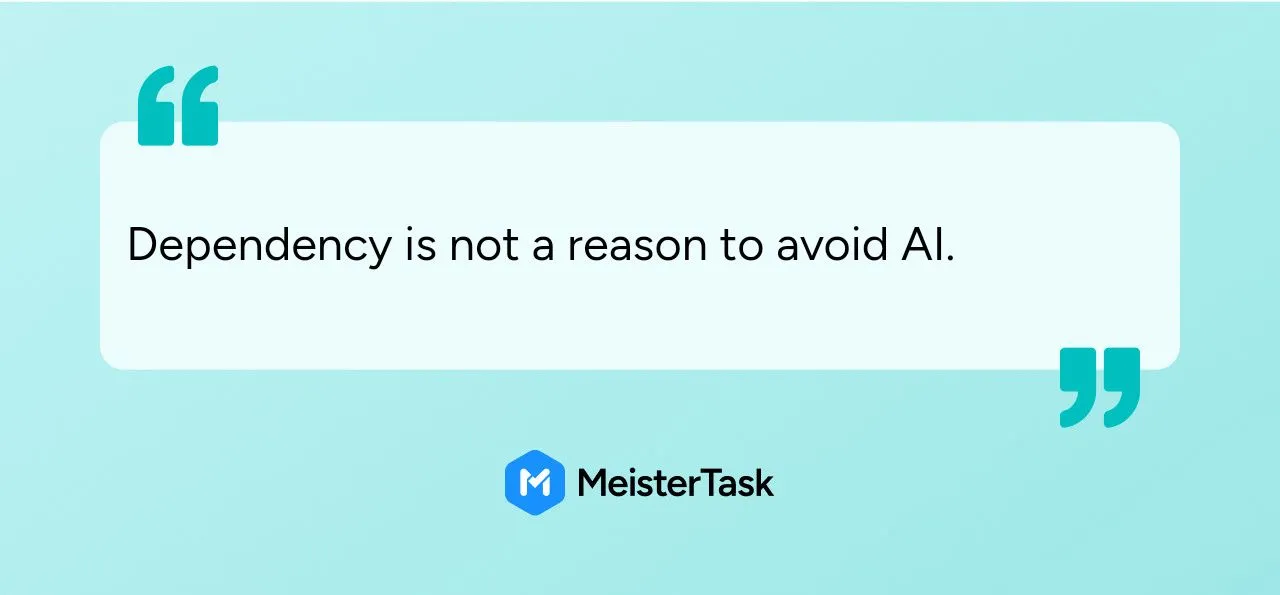
It is a reason to know where a single tool has become a single point of failure.
AI risk management frameworks: what they cover and what they leave out
Two frameworks shape most conversations about AI risk, and it helps to know what each one does.
The NIST AI Risk Management Framework is a voluntary US standard built around four functions: govern, map, measure and manage. It is strong on what to assess and why, and it gives teams a shared vocabulary for AI risk. The EU AI Act takes a different approach. It is mandatory for organizations operating in the EU to classify AI systems by risk level, with obligations that increase as risk rises. For any team in the DACH region, it is the more immediate concern.
Both frameworks describe what needs to happen. Neither tells you which tasks to run on a Tuesday, where to record a decision or how to keep the whole thing current six months later. That operational gap, between knowing the principles and running the process, is what the rest of this article covers.
How to implement AI risk management in your team: five steps
Frameworks give you the principles. This is where they become daily work your team can run and see. The five steps below follow the same project-planning process you would use for any structured initiative: start with an inventory, assess, decide, document, and review. Each step maps to a feature in MeisterTask, so the work lives where your team already works rather than in a document nobody reopens.
1. Inventory your AI tools
You cannot manage risk you cannot see. Start by listing every AI tool in use across the team, who uses it, what data it touches and whether anyone has reviewed it. In MeisterTask, create a dedicated project and add one card per tool. Custom fields let you capture the details that matter: tool name, data classification, data processing agreement status, EU AI Act risk level and review date. Assign each card a clear owner, the way a RACI matrix clarifies accountability, so every tool has a named person responsible for it.
The hardest tools to inventory are the ones nobody reported. Unapproved AI use, sometimes called shadow AI, spreads when people reach for whatever helps them finish a task. Ask each team directly what they use, rather than assuming the official list is complete.
When the inventory starts with a brainstorming session, MindMeister lets you map out all the AI tools your team uses in a mind map, then push each one straight into MeisterTask as a task card.
For a structured approach to rolling out AI tools before they go underground, see our article on introducing AI tools to your team.
2. Assess each tool against the four risk categories
With the inventory in place, work through the four risk categories for each card. Rate every tool by how likely a problem is and how much damage it would cause, borrowing a structured scoring method, such as building a risk matrix. Record the reasoning directly on the card as a task comment, which timestamps the note and attributes it to the author. That comment becomes your evidence that the assessment happened, not just that someone remembers doing it.
3. Classify and decide
Every assessed tool needs a decision: approved, approved with conditions, under review or rejected. Create a board section for each status and move each card into the one that fits. The result is a live AI risk register that anyone with access can read at a glance. When a tool's status changes, you move its card, and the board stays up to date without a separate report.
4. Document your compliance decisions
Approval is not the end of the work; the record of it is. Attach the signed data processing agreement to the card, log sign-off from compliance or legal as a comment and note any conditions attached to the approval. Strong project documentation practices turn scattered approvals into a single audit trail, which is exactly what a regulator or auditor will ask to see. When the evidence lives on the card, you are not rebuilding history under pressure months later.
5. Schedule ongoing reviews
AI tools change, and so do the rules around them. Set a recurring task to review each approved tool on a fixed cadence, quarterly for most teams. Each review checks four things: data-policy changes, how usage has shifted, new regulations and cost. Treat the outcomes the way you would the project metrics you already track, so trends stay visible over time. As with the review workflow you run for any project, this continues as long as the tool is in use, and a tool that fails a review is reclassified or retired.
AI risk management for GDPR and the EU AI Act
For teams in the EU and the DACH region, two obligations shape almost every AI decision. Both reward the same habit: written evidence that you assessed the risk and acted on it.
GDPR applies to any AI tool that processes personal data. You need a data processing agreement with the vendor, data minimization in what you send and, for automated decisions, a possible right to explanation for the people affected.
The EU AI Act classifies tools by risk level. Most general-purpose business tools fall into limited or minimal risk, but uses such as HR screening, credit scoring or biometric identification can be high-risk and carry heavier duties.
Documentation is the shared requirement. Both regimes expect you to show that risks were assessed and mitigated, and task comments and attached agreements provide that trail without a separate compliance system.
Where MeisterTask fits (and where it doesn't)
MeisterTask is not a dedicated AI risk management platform, and it is worth being clear about that. MeisterTask is the coordination layer: the place where your team tracks which AI tools are approved, records how each assessment was made and keeps compliance decisions current over time. For organizations with heavy governance, risk and compliance needs, dedicated platforms such as ServiceNow, OneTrust or LogicGate handle formal GRC programs. MeisterTask sits alongside those systems as the operational layer where the daily work of assessing, deciding and reviewing gets done.
Turn AI risk decisions into tracked work
AI risk management is less about paperwork and more about visibility: knowing which tools your team uses, what each one does with your data and whether that use still holds up. Frameworks tell you what to assess. A working process tells you how to: inventory your tools, assess each one, classify it, document the decision, and review on a schedule.
MeisterTask brings that process into one place, so AI oversight becomes organized, transparent and secure work rather than a spreadsheet nobody maintains. Hosted in Germany, ISO 27001 certified and fully GDPR compliant, it fits the compliance-minded team well. Bring the same structure that keeps a whole team aligned on progress to your AI decisions, and a vague obligation turns into steady, trackable progress.