
What is digital sovereignty?
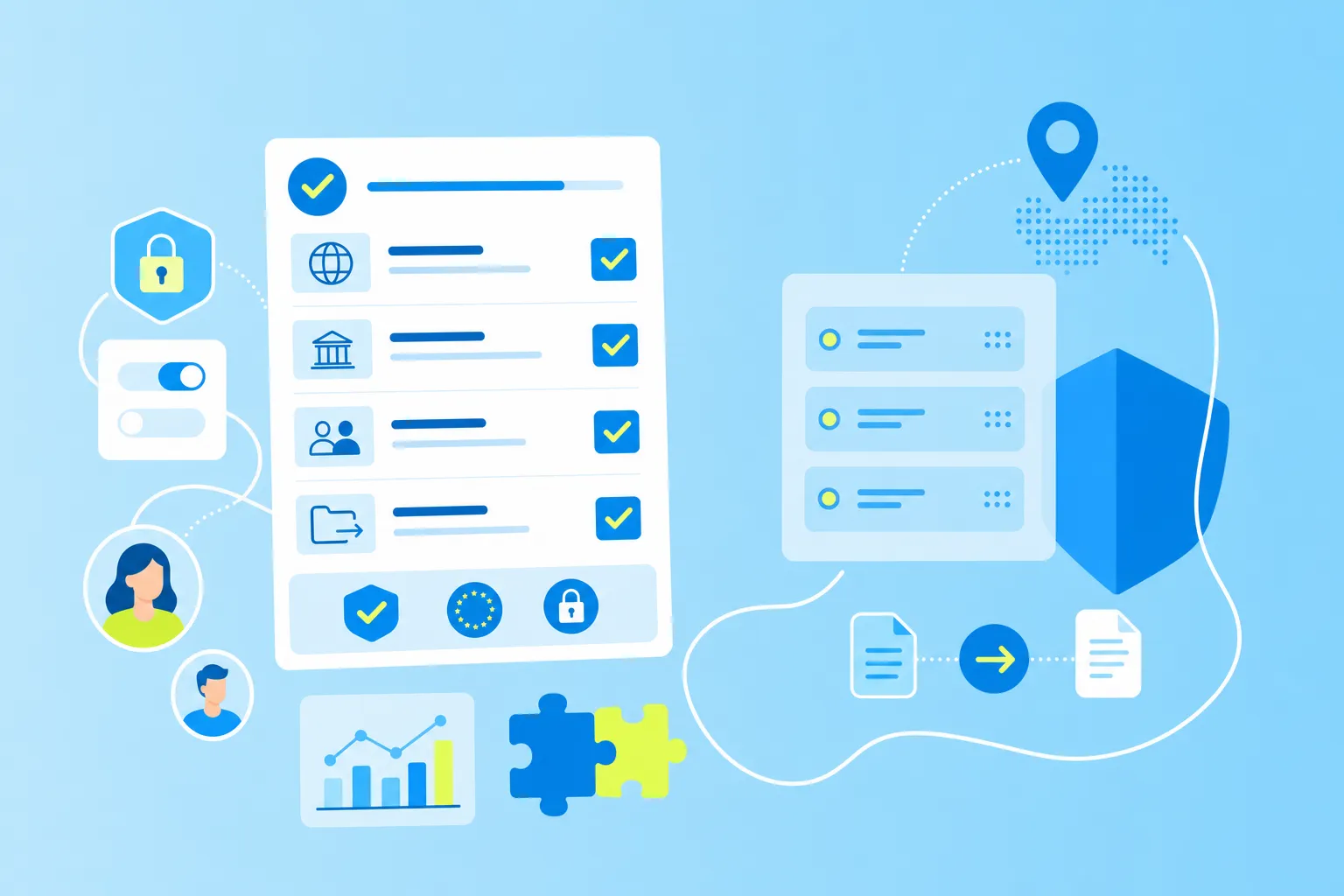
Digital sovereignty is the ability of an organization to control its own data, software and digital infrastructure without being subject to foreign jurisdictions. For European organizations, it means using tools that store data in Europe, operate under European law and stay accessible without dependence on non-European vendors.
The term started in European policy debates about technology dependence. After Schrems II in July 2020, it moved into procurement questionnaires next to security and data protection checks. Related terms get mixed up with it:
Digital autonomy: A region or state can make strategic technology choices without depending on other powers.
Data sovereignty: An organization controls specific datasets, including who may use them and for what purpose.
Data residency: Data is stored and processed in a known physical location, such as a data center in Frankfurt.
GDPR compliance: A vendor meets the EU's baseline for handling personal data, which every vendor serving European customers needs.
Data residency tells you which building your files sit in. Jurisdiction tells you who can demand the keys.
Why digital sovereignty matters now
Three forces turned digital sovereignty from a policy debate into an operational concern. They are the Schrems II ruling, the US CLOUD Act and EU policies such as the Digital Decade and Gaia-X.
The Schrems II ruling
On July 16, 2020, the Court of Justice of the European Union (CJEU) ruled in case C-311/18, known as Schrems II. The court invalidated the EU-US Privacy Shield, the framework that many companies used to send personal data to the US. Standard contractual clauses (SCCs) stayed valid, but transfers based on them now need an assessment of the destination country's law.
The ruling did not ban transfers to the US. It made each transfer a legal judgment that someone in your organization has to own. The European Commission adopted the EU-US Data Privacy Framework on July 10, 2023, as a new basis for transfers.
The EU General Court dismissed a challenge to that framework on Sept. 3, 2025, and an appeal (Case C-703/25 P) has been pending at the Court of Justice since Oct. 31, 2025. Tools that do not depend on a single transfer framework hold up better.
The US CLOUD Act
The US CLOUD Act was passed in 2018. It lets valid US legal process require providers under US jurisdiction to disclose data in their possession, custody or control, wherever it is stored.
A European subsidiary of a US company may still be reached. According to the US Department of Justice, whether the law covers a given subsidiary is a fact-dependent question that turns on who controls the data. A vendor with a US parent should be able to explain how that applies to its own structure.
The CLOUD Act operates through a legal process with limits, so it does not grant blanket access to EU data. Still, "hosted in Frankfurt" answers only the location question.
The EU Digital Decade and Gaia-X
The European Commission's Digital Decade program sets targets for 2030. They include wider use of cloud, AI and big data by European enterprises, plus more secure edge infrastructure.
Gaia-X is a non-profit association that builds specifications, rules and a verification framework for federated, trustworthy data and cloud services. It does not run its own cloud or certify tools as sovereign. Together, the two make European capacity official policy, but neither tells you whether a specific tool is sovereign.
Digital sovereignty vs GDPR compliance: why they are not the same
GDPR compliance means a tool follows the EU's data protection rules. Digital sovereignty means the tool is not subject to non-EU jurisdictions that could override those rules. A US-based tool can be GDPR-compliant and still be reachable under the CLOUD Act.
Think of GDPR as the floor. It sets the minimum for lawful processing, data subject rights and security. It does not decide which country's courts can reach a vendor's parent company. Digital sovereignty is the layer you add on top when that risk matters, usually in three situations:
Sensitive data: Health records, HR files and confidential product designs carry higher stakes if a foreign authority requests them.
Regulated industries: Finance, healthcare and critical infrastructure face sector rules and contracts that ask where data sits and who controls it.
Public sector contracts: Authorities and their suppliers often must document sovereignty criteria in tenders.
Our article on data protection made in Europe explains what EU data protection looks like beyond baseline compliance. The rest of this article focuses on the sovereignty layer, starting with location.
Where is your data stored? The data residency question
Data residency is the physical location where data is stored and processed. Digital sovereignty is necessary but not sufficient. Data stored in Frankfurt by a US-owned provider may still fall under US jurisdiction.
Vendors often answer residency questions with a short label. When a vendor says "EU hosting," ask four follow-up questions:
Primary storage: Ask which country and data center host your live data, and whether the contract specifies that location.
Backups: Ask where backup copies and disaster recovery sites are located, because they can be in a different region.
Processing and support access: Ask where data is processed and from which countries support staff can view it.
Legal entity in control: Ask which company operates the servers and which parent company owns that entity.
Picture a procurement lead at a midsize logistics company whose vendor answers "EU hosting." Storage and backups are in Germany, but support tickets are routed through the vendor's US parent company, which can access customer data. That finding does not disqualify the vendor, but it shows which risk the lead would accept and which terms to negotiate.
A checklist for evaluating digital sovereignty
Use these five questions in any vendor review, whether you compare established platforms or shortlist European alternatives to US tools. Ask for written answers, because vague replies are a signal too.
1. Where is the data stored and processed?
Split the location into three parts: primary storage, backup storage, and processing. A vendor can store live data in Germany while running backups or analytics elsewhere. Processing matters too, since data is exposed wherever it is read.
Accept only answers that name specific EU data center locations, such as Frankfurt or Paris, because "EU region" is too vague to verify. Ask whether those locations appear in the contract or data processing agreement (DPA) and how the vendor tells you before they change.
2. Which legal jurisdiction applies?
The legal entity that operates the service determines which law applies. A tool hosted in Germany by a US-owned company can still be subject to US law, including the CLOUD Act.
Check the operating entity named in the contract and where it is registered, then review the parent company and ownership structure. Finally, check the infrastructure sub-processor, because a European vendor may run on a cloud platform with a non-EU parent.
3. Who has access, and under what circumstances?
Document every party that can reach your data and the conditions that apply. Cover these groups:
Vendor staff: Find out which roles can view customer data, from which countries and with what approval.
Sub-processors: Request the full list, including what each one processes and where.
Cloud infrastructure providers: Check whether the hosting provider's staff can reach your data and under which legal system.
Government authorities: Ask how the vendor handles government requests and whether it notifies customers when permitted by law.
Ask for the DPA and the sub-processor list before you sign. Both documents turn verbal promises into terms you can check.
4. What are the exit options?
Check that you can export all your data in a standard format, such as CSV or JSON, at any time. Ask in writing what the export leaves out, because attachments, comments or history can need separate handling.
A municipal IT team can test this before signing. The team exports a small pilot project and opens the files in another tool, such as a spreadsheet. If tasks, owners and due dates come through intact, the exit option has passed a real test.
5. What certifications and standards does the vendor hold?
Certifications indicate operational maturity, though none of them proves sovereignty on its own. Look for these:
ISO 27001: This international standard covers information security management.
BSI C5: The German Federal Office for Information Security (BSI) sets minimum requirements for secure cloud computing in this catalog.
TISAX: The ENX Association runs this information security assessment for the automotive supply chain.
At the EU level, ENISA, the EU Agency for Cybersecurity, is still developing the EU cloud certification scheme (EUCS). Treat any EUCS certification claim with caution until the scheme is adopted.
Digital sovereignty for public sector organizations
Public bodies face stricter digital sovereignty requirements than most private companies. German federal agencies must require BSI C5 evidence when they buy external cloud services that process official data. The European Commission applies its own Cloud Sovereignty Framework, published in October 2025, in its cloud procurement.
The framework grades offers on assurance levels from SEAL-0 to SEAL-4. It is a procurement tool rather than a law, but other public bodies can borrow its scale. National initiatives in Germany and France point in the same direction:
Deutsche Verwaltungscloud: Germany's IT-Planungsrat adopted this strategy framework in 2021 to establish a common cloud approach across the public administration.
ZenDiS and openDesk: The Center for Digital Sovereignty of Public Administration (ZenDiS) provides open-source offerings, including openDesk, for public administrations.
SecNumCloud: France's cybersecurity agency ANSSI runs this qualification, which includes criteria on EU headquarters, ownership and protection from non-EU law.
If you are preparing for a public sector tender, the checklist above gives you a structured way to document hosting, ownership, sub-processors, certifications and exit terms. For an example of how a task management vendor answers these questions, see the MeisterTask public sector page.
MeisterTask and digital sovereignty
MeisterTask stores project data in an ISO 27001-certified data center in Frankfurt, Germany. The contracting entity is MeisterLabs GmbH, a company registered in Vaterstetten, Germany, and subject to German and EU law. The infrastructure runs on Google Cloud's Frankfurt region, so review the DPA's sub-processor list against your own threshold. Applied to the checklist, three facts stand out:
Data residency: MeisterTask project data is hosted in Frankfurt, and MeisterLabs is certified to ISO 27001:2022.
Jurisdiction and transparency: The DPA lists Google Cloud EMEA Limited, whose parent company is in the US, alongside other sub-processors.
Exit options: All users can export projects to CSV, including tasks, assignees, due dates, comments and checklists. Attachments download separately, whereas a personal data export bundles projects and attachments into a single ZIP file.
Meister AI combines a search model built by MeisterLabs with models from Google and OpenAI, both US providers. Google and OpenAI do not use information processed by Meister AI to train their models. Since "hosted in Germany" covers only project data, Business plan admins can disable AI features while keeping core task management. Our article on AI risk management explains how to weigh that choice.
Consider a manufacturing team that stores confidential supplier drawings in its projects. The team admin disables AI features, and the team keeps its tasks, deadlines and handoffs in MeisterTask. Hosting and certification details are on the MeisterTask security page.
Make sovereignty part of every tool decision
Digital sovereignty is a set of questions you ask every vendor, and no single label answers them. Each time a vendor says "EU hosting," run the five checks on storage, jurisdiction, access, exit and certifications to see which risks you accept.
MeisterTask documents its hosting, sub-processors and AI providers, so your team can judge them against its own threshold.