
What is healthcare project management?
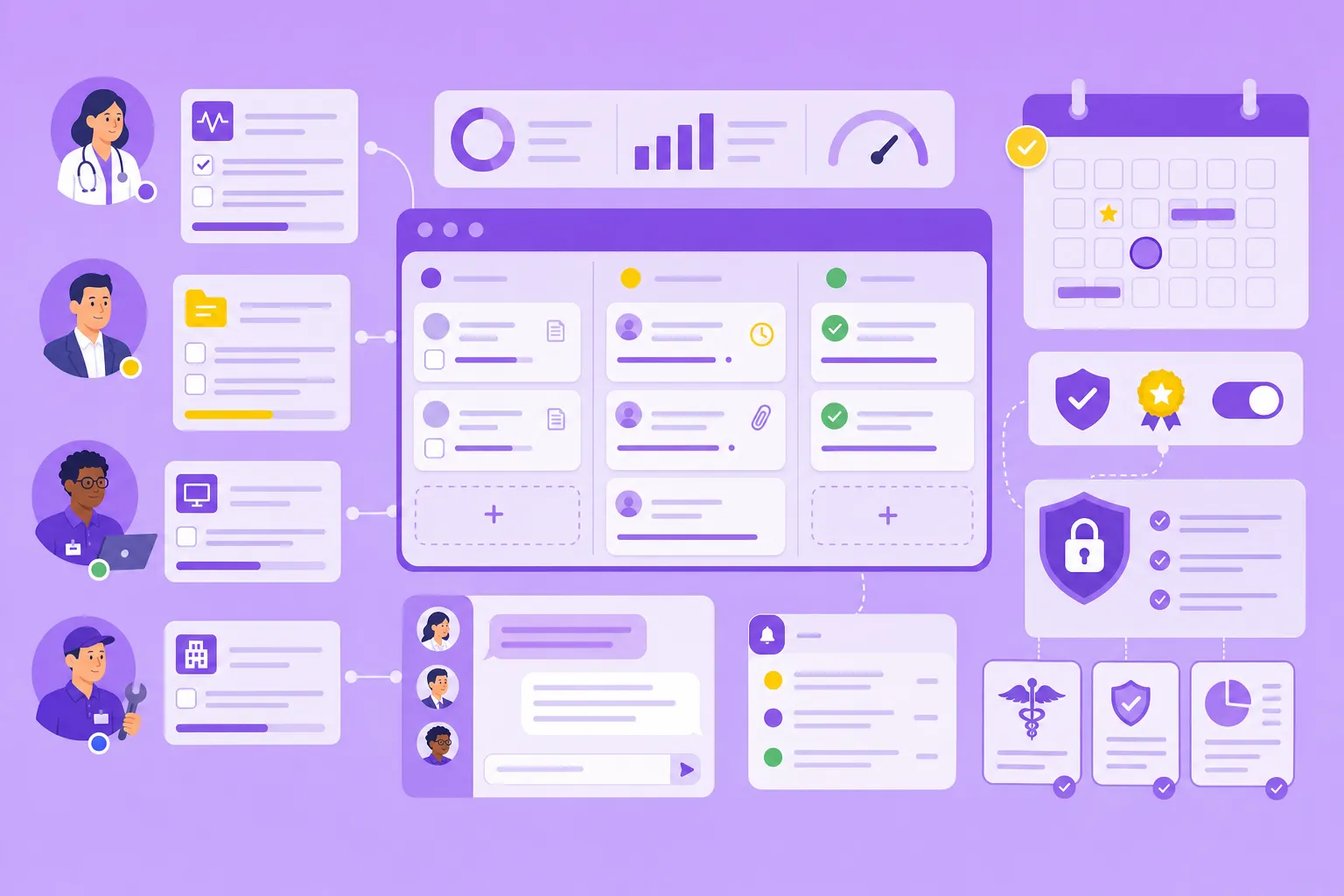
Healthcare project management is the practice of planning, coordinating and tracking administrative and operational work across clinical and non-clinical teams. It covers projects like compliance audits, facility upgrades, patient-flow improvements and policy rollouts, rather than direct patient care. It applies established project management practice to the specific demands of a healthcare setting.
Unlike general project management, healthcare projects carry extra constraints. Work must meet strict data protection and regulatory requirements, such as the GDPR in Europe, as well as national rules for handling health data. Projects depend on many departments at once, from clinical staff to admin, IT and facilities. And there is little room for dropped tasks when patient outcomes are at stake.
Because of those constraints, teams need a workspace they can trust from day one. MeisterTask gives healthcare teams a GDPR-compliant, EU-hosted workspace they can set up themselves without a dedicated IT project.
What makes project management in healthcare different?
Healthcare projects are not harder than other projects. They are more constrained, which is why researchers increasingly treat project management in healthcare as an organizational competence in its own right. Three factors set them apart from general project work:
Regulatory compliance is not optional. Every task tied to a regulation needs a record of who did what and when, so the team can produce an audit trail on demand.
Cross-department coordination is the norm. A single initiative usually touches clinical, admin, IT and facilities teams at the same time, and each one owns a piece of the outcome, which makes strong collaboration between stakeholders essential.
The stakes are higher. A missed compliance deadline or a delayed facility upgrade does not just push back a timeline. It can affect patient care and expose the organization to real risk.
These factors shape every decision about how to plan and track the work, and they are part of why leading institutions now teach project management as a core healthcare skill. A method that works for a marketing campaign will not hold up when an auditor asks for evidence or when a delayed equipment install blocks a clinic from opening. Healthcare teams need a structure that makes ownership clear, keeps documentation up to date, and gives leaders a real-time view of where each project stands.
What are the most common healthcare project types?
Most administrative and operational work in healthcare falls into a handful of recurring project types. Knowing which type you are running helps you choose the right structure, owners and documentation from the start.
1. Compliance and accreditation projects
These projects prepare the organization for regulatory audits, update internal policies and train staff on new requirements. They are recurring, deadline-driven and heavy on documentation, so a clear record of who completed each step matters as much as the work itself. A risk matrix that ranks gaps by likelihood and impact helps the team fix the most serious ones first. For example, an annual GDPR compliance review might run across every department, with each one responsible for gathering and storing its own evidence.
2. Facility and infrastructure projects
This type covers renovations, equipment upgrades and new technology rollouts across one or more sites. They often involve outside vendors and tight scheduling around clinical hours, which makes clear deadlines and dependencies essential. For example, a team might install a new patient check-in system across three clinic locations without disrupting daily appointments.
3. Patient flow and process improvement
These projects aim to reduce wait times, streamline intake and improve handoffs between teams. They tend to be iterative, with small changes tested and measured over time before they become standard practice. For example, a clinic might redesign the referral workflow from a general practitioner to a specialist to cut delays for patients.
4. Staff onboarding and training
This type includes credentialing, orientation programs and continuing-education tracking. Each new hire moves through a repeatable set of steps that has to be documented. For example, a department might onboard 10 new nurses across two units, with a compliance checklist to complete for each person.
5. IT and digital transformation
These projects modernize systems: migrating electronic health records, rolling out telehealth or improving cybersecurity. They are high-risk because they affect data privacy and daily clinical operations simultaneously, so careful sequencing is critical. For example, a team might migrate patient records to a new EHR system within a 12-week window while keeping the old system available as a fallback.
Why do healthcare teams struggle with project management?
The problem is rarely a lack of effort. Most healthcare teams work hard and care deeply about getting things right. The trouble is that the work is spread across tools that were never built to connect, so effort leaks out at the seams. Four issues come up again and again:
Too many communication channels. Clinical notes live in the EHR, admin tasks in email, policy updates in shared drives and facility requests on paper, so nothing connects and no one sees the full picture.
No single owner for cross-department work. A compliance audit touches every department, but nobody owns the overall timeline, so tasks fall between teams because ownership is assumed rather than assigned.
Compliance documentation is manual. Regulatory tasks get tracked in spreadsheets that are hard to search, quick to lose track of and difficult to audit when it counts, which is where structured compliance documentation makes the difference.
Resistance to new tools. Clinical and admin staff already juggle systems for the EHR, scheduling and billing, so any new tool has to be usable in one session, not over weeks of training.
Each of these issues compounds the others. When ownership is unclear and documentation is scattered across files, a single audit request can leave a team scrambling for days. Think of it like a relay race where no one is sure who holds the baton: the moment it changes hands, work stalls. The fix is not more effort. It is a shared workspace where every task has an owner, every step is recorded and everyone works from the same view.
How do you manage healthcare projects in MeisterTask?
MeisterTask turns scattered healthcare work into structured, trackable projects that any team can run without technical setup. The goal is not to add process for its own sake, but to give every project a clear home, a clear owner and a clear record. Here is how to get started in five steps.
1. Start with the healthcare workflow template
MeisterTask includes a ready-made healthcare workflow template with To Do, In Progress, Review and Complete sections already in place. Open it, then adjust the sections and tasks to match your first project. You get a working structure in minutes instead of building a board from scratch.
2. Create one board per project type
Set up a separate board for each type of project: one for a compliance audit, one for a facility upgrade, one for staff onboarding. Keeping project types on their own boards makes each one clean and quick to navigate. Team members find what they need without having to scroll through unrelated work.
3. Assign every task to one person
 In MeisterTask, give every task exactly one owner and one deadline so responsibility is never in doubt, and use a clear ownership model, such as a RACI matrix, to keep roles straight when several teams are involved. Task assignment makes ownership visible to the whole team, which closes the gaps where work usually stalls.
4. Use checklists for compliance steps
Attach a checklist to each compliance task that lists every step to complete and document. As people check off items, the checklist builds a record that stays with the task, and workflow automation can schedule recurring compliance tasks so they never slip. That record becomes part of your audit trail, ready the moment someone needs proof of what was done.
5. Use Notes for policy and procedure documentation
Store standard operating procedures, compliance policies and training material in Notes, linked to the relevant board. Keep one current version of each document and note when it was last reviewed, so nobody works from an outdated copy. Clear documentation means that when an auditor asks for evidence, it is already organized and connected to the work it supports. Your team spends time on the project instead of hunting for the latest version of a policy.
What should you look for in healthcare project management software?
Not every project tool fits a healthcare setting. The features that matter most are the ones that protect data, earn adoption and hold up under scrutiny. A general productivity app may look appealing, but it can fall short on privacy or leave no reliable record. Evaluate any option against these four criteria, and see how MeisterTask measures up on each.
GDPR and data compliance
Even administrative data in healthcare is closely linked to patient information, so it requires EU hosting and a data processing agreement. Look for a vendor that can prove its security standards with independent certification rather than just claiming them. MeisterTask is GDPR-compliant, ISO 27001 certified and hosted in Germany, which keeps your data under EU privacy law.
Adoption speed
Clinical and admin staff will not adopt a tool that takes weeks to learn on top of their existing systems. The right software is usable in the first session, without a dedicated rollout or IT support. MeisterTask uses visual Kanban boards that are quick for new team members to pick up, so adoption does not depend on a long training plan.
Audit trail
Every action, comment and status change should be timestamped and tied to a named user, so you can reconstruct the history of any project. This is what turns everyday work into audit-ready evidence, without asking anyone to keep a separate log. MeisterTask records this automatically: task comments and activity are timestamped and attributed to the person behind each entry, so the trail builds itself as the team works.
Role-based access
 Admin, compliance and facility boards often need different access levels for different teams. MeisterTask handles this with project-level permissions, so people see the boards they need and nothing they should not.
Turn healthcare project chaos into clear, trackable work
Healthcare project management is not about adding more complexity to already busy teams. It is about coordination and audit-ready structure: clear ownership, connected documentation and a live view of where every project stands. When those pieces are in place, compliance reviews, facility upgrades and onboarding all move forward with far less friction.
MeisterTask brings that structure into one organized, transparent and secure workspace, so healthcare teams can plan the work, track it and prove it was done. As your projects grow, the same setup scales with them without a heavier process. To see how other teams use it, explore MeisterTask for healthcare and build your first board.