
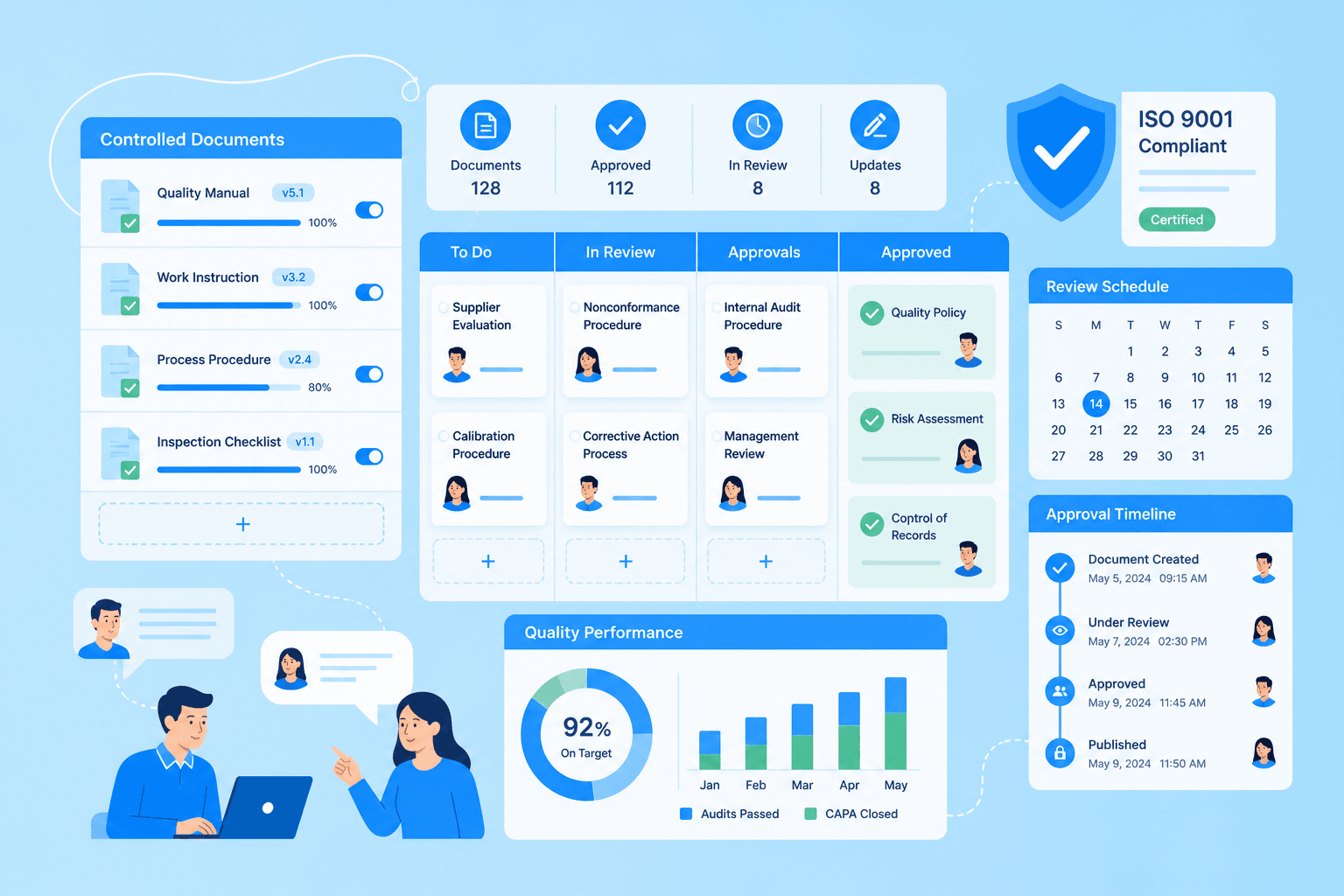

What is ISO 9001 and why documentation matters
ISO 9001 is the international standard for quality management systems (QMS). It provides a framework for organizations to deliver consistent quality, meet customer requirements and continuously improve how they operate. Over one million organizations worldwide hold ISO 9001 certification, spanning industries from manufacturing and logistics to healthcare and professional services.
For manufacturing teams, ISO 9001 certification often opens doors to new contracts, especially with larger customers who require suppliers to demonstrate quality controls. The certification signals that your organization follows defined processes, measures results and acts on what it learns.
Documentation matters because the standard requires you to prove your quality processes are planned, executed, and improved. You cannot claim that your processes work without proof; you need written evidence to support the claim. However, this does not mean generating mountains of paper. ISO 9001:2015 calls for a "documented quality management system," not a "system of documents." The difference is significant: the first supports your work, while the second buries it.
What does ISO 9001 documentation include?
When quality managers hear "documentation," they often picture thick binders and rigid templates. The reality under ISO 9001:2015 is more flexible. The standard specifies what information you must control, but it leaves the format, the tools, and the level of detail largely up to you. This flexibility lets you scale documentation to your organization's size, process complexity, and team competence. A ten-person machine shop needs far less written detail than a pharmaceutical manufacturer with hundreds of production steps.
Mandatory documents and records
ISO 9001:2015 defines "documented information" as two categories: documents you maintain and records you retain. Documents describe how something should work. Records prove it happened.
Documents to maintain (four required):
Scope of the QMS (clause 4.3)
Quality policy (clause 5.2)
Quality objectives (clause 6.2)
Criteria for evaluating and selecting suppliers (clause 8.4.1)
These four tell the story of what your QMS covers, what your quality commitments are, what you are trying to achieve and how you choose the suppliers that contribute to your product quality.
Records to retain (around 18, where the clause applies):
Training and competence evidence (7.2)
Monitoring and measuring equipment calibration (7.1.5.1)
Product or service requirements review (8.2.3.2)
Design and development inputs and outputs (8.3)
Supplier evaluation and performance (8.4.1)
Nonconformity and corrective action (10.2)
Internal audit results (9.2)
Management review results (9.3)
The list of records is longer because records capture evidence of activities. If a clause applies to your operations, you keep the record. If it does not, you skip it. A company that does no design work, for example, has no design records to keep.
Consider a small metal fabrication shop. It purchases raw materials, cuts and welds components, inspects finished parts, and ships to customers. That shop needs records for supplier evaluation, incoming inspection, calibration of measuring tools, customer requirements review and any nonconformities found during production. It probably does not need design records, because it builds to customer specifications rather than developing its own products.
What the standard does not require
A common misconception is that ISO 9001:2015 still mandates the six documented procedures from the earlier 2008 version. It does not. The 2015 revision removed that requirement entirely. You may still write procedures where they are helpful, but the standard does not require you to produce them.
The quality manual is also optional. Many organizations still find a manual useful for an overview of their QMS, but the standard no longer requires one. There is no mandated format, no required forms and no prescribed cross-referencing system. The extent of your documentation scales with your operations' requirements: smaller organizations with straightforward processes may document far less than large, complex operations.
This flexibility is intentional.
Organizations that embrace this mindset focus their documentation effort where it adds value: clarifying critical processes, capturing essential evidence and enabling continuous improvement.
The most common ISO 9001 documentation mistakes
Even teams that understand the standard's flexibility fall into patterns that make certification harder than it needs to be.
Too much documentation. Documenting every conceivable task generates volume without value. When everything is documented, nothing stands out and the team spends time maintaining paperwork instead of improving quality. Focus on what the standard requires and what genuinely helps your operations.
Documents that fall out of date. A procedure written three years ago may no longer reflect how the team works today. Without version control and scheduled reviews, outdated documents stay in circulation. Auditors will notice when the documented process does not match reality.
No audit trail. Auditors need evidence that procedures were followed, not just that they exist. If you cannot show who did what and when, you lack the records the standard requires. Approvals, changes and reviews should leave a traceable history.
Documentation nobody can find. If the quality manager is the only person who knows where documents live, the system is fragile. The team should be able to access controlled documents when needed, without digging through shared drives or email attachments.
These problems share a root cause: documentation that lives outside daily work. When quality records are stored in a separate system (or worse, a filing cabinet), they fall behind. When documentation lives where the team already works, it stays current.
Managing ISO 9001 documentation in MeisterTask
MeisterTask provides a straightforward way to organize quality documentation inside the workflow your team already uses. Instead of managing controlled documents in a separate folder or spreadsheet, you can track them alongside the tasks they relate to.
1. Create a quality documentation project. Set up a dedicated board for your QMS documentation. Use sections (columns) to represent process areas: incoming inspection, production, shipping, and complaints. Each section groups the documents that apply to that workflow.
2. Add each document as a task card. Give each document its own card. The card title matches the document name. Custom fields capture the current version number, the document owner, and the next scheduled review date. This structure makes the full inventory visible at a glance.
3. Use recurring tasks for document reviews. MeisterTask can auto-assign a review reminder to the document owner before the scheduled date. When the reminder appears, the owner reviews the document, updates the version if needed and marks the task complete. The next recurrence is already waiting.
4. Attach the document. Upload the current PDF or link to its location in the task attachments. The attached file sits alongside the version history and review notes, so auditors see the full picture in one place.
5. Use task comments as the audit trail. Every change, review and approval is timestamped and tied to a named user. When someone updates a document, they add a comment explaining what changed. When a manager approves, the comment logs the approval. This history is automatic and permanent.
6. Share with auditors. Grant view access to the board so auditors can review full document history without requesting paper files or scheduling walkthroughs. They see the same board your team uses daily, which demonstrates that controlled documents are part of your real workflow.
This approach works because it integrates documentation into the routine your team already follows. A quality manager at a food-packaging company, for example, might set up sections for receiving inspection, line changeover procedures, finished-goods release and customer complaints. Each document lives in the section where the team encounters it, not in a separate archive they rarely visit.
MeisterTask is EU-hosted, fully GDPR-compliant and ISO 27001 certified. These credentials matter to manufacturing teams in regulated industries who need assurance that quality records are stored securely and handled in accordance with recognized standards. For broader compliance documentation practices beyond ISO 9001, a separate article on compliance documentation types and systems covers the fundamentals.
ISO 9001 requirements: what auditors actually check
Understanding what auditors look for can reduce anxiety and sharpen your focus. Auditors are not looking for the most impressive documentation; they are looking for evidence that your processes work and improve.
Controlled documents. Is the current version in use? Are outdated copies removed from circulation? Auditors compare what they see on the floor (or in your system) with what the documented version says. Discrepancies raise questions.
Evidence that procedures are followed.
Auditors want to see training logs, inspection results, calibration certificates and corrective-action reports. These records prove the work happened according to the process.
Evidence of improvement. Nonconformities happen. What auditors want to see is that you identified the problem, took corrective action and tracked it to completion. A culture that hides nonconformities fails audits; a culture that documents and resolves them passes.
Imagine a production line discovers that a batch of parts fails dimensional inspection. The auditor wants to see the nonconformity report, the root-cause analysis, the corrective action taken and evidence that the fix worked. That chain of records, linked and timestamped, demonstrates a learning quality system.
If you can show an auditor exactly which version of a document was in effect on a given date, who approved the last change, and when the next review is due, you have demonstrated control. Add records that prove activities happened as documented and you have the foundation for a successful audit.
Turn compliance documentation into everyday clarity
ISO 9001 rewards clear evidence over sheer volume. The standard does not ask you to generate paperwork for its own sake; it asks you to prove your quality processes are defined, followed and improved. When documentation lives where your team already works, it stays current. When reviews are scheduled and visible, nothing falls through the cracks. When every change is timestamped and tied to a person, the audit trail writes itself.
MeisterTask provides manufacturing teams with a lightweight coordination layer to manage controlled quality documentation. Because it brings tasks, documents and communication into one workspace, it reduces the distance between work and evidence. Compliance becomes part of the daily rhythm, not a quarterly scramble. Organized work, transparent progress and secure collaboration: these are the foundations of a quality system that works for the team, not against it. Ready to bring quality documentation into your team's daily workflow?