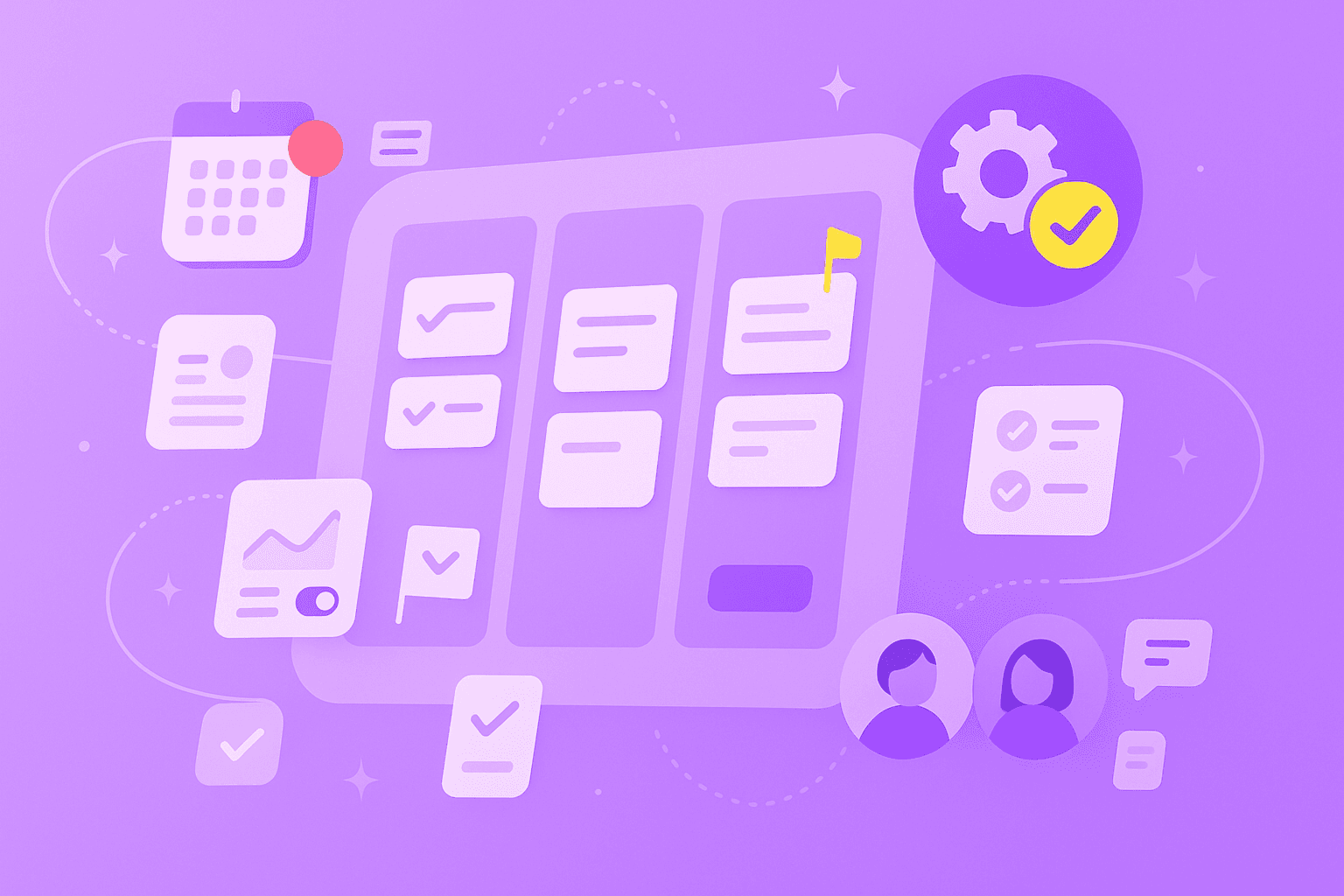


What a kanban board template gives you
A kanban board template is a starting structure, not just three columns on a screen. It maps the stages your work goes through, from the initial request to the final result. You then adjust it to fit how your team already operates.
Think of it as the difference between a blank spreadsheet and one that already has the right headers in place. The columns give shape to the flow before the first card ever lands.
Here is what a good kanban template provides:
Columns: Each column represents a stage in your workflow, so every piece of work has a clear place to sit.
Cards: Each card is a single work item that moves from left to right as it progresses.
A ready structure: You start from a proven layout instead of building a board from scratch.
Change the columns and you change what the board can show you.
If you want the theory behind the method, our article on what Kanban is covers the fundamentals. Here, we stay focused on the board you can put to work this week.
Why does the default three-column stop working
To Do, In Progress, and Done work well on day one. Every task is either waiting, moving or finished, and anyone can read the board at a glance. The trouble starts once your work has more than three real stages.
Picture a marketing team running a campaign. Their In Progress column quietly supports drafting, design, and review simultaneously. A blog post stuck in design looks identical to one awaiting final sign-off. Nobody can tell where the campaign is slowing down, so the team lead ends up asking for updates in chat.
The default layout hides the exact information a project manager needs:
Everything piles in one column: Half the board sits in In Progress, so the column stops telling you anything useful.
No visibility into handoffs: You cannot see when work passes from one person to the next, which is where most delays start.
Blocked work looks active: A task waiting on a client appears to be moving, so it slips off the radar for days.
The fix is not more tools. It is a kanban board built around the stages your team already works through.
Four kanban board templates for different teams
The best columns are the ones that mirror your team's real stages. Each template below is a starting point, ready to open and shape to the way you already work.
Marketing team template
Content and campaign teams rarely move work in a single hop. One deliverable passes through writing, design and at least one round of review before it goes live.
Columns to start with:
Backlog
Ready
Writing
Design
Review
Scheduled
Published
Splitting the middle stages shows you where a piece is sitting at any moment. A blog post parked in Design reads very differently from one waiting in Review, so the team lead knows whether to chase a designer or an approver. The Scheduled column also separates work that is truly finished from work that is only queued for publication, which prevents the board from looking busier than it is.
Operations team template
Operations and service teams work from a queue of requests they do not fully control. Some items stall because someone outside the team has to respond first.
Columns to start with:
Requests
Triage
In progress
Waiting on others
Review
Done
The Triage column gives you a moment to sort and prioritize before anything starts. The Waiting on others column is the one that earns its keep: it pulls blocked work out of In progress, so a request waiting on a client or a vendor no longer looks active. That single change makes bottlenecks obvious in a daily standup and gives the team a clear list of things to unblock.
Manufacturing team template
Small and mid-sized manufacturers track a physical flow, not just digital tasks. Each column stands for a real handoff on the floor.
Columns to start with:
Order received
Materials ready
In production
Quality check
Packaging
Shipped
A production order waits in Quality check until it passes, then moves to Packaging. If orders start stacking up before the quality check, leadership can see the backlog forming and act before it delays a shipment. The board becomes a shared status view for a team that is often split between the office and the shop floor, where a quick glance replaces a round of phone calls.
Software team template
Product and development teams usually separate the work being built from the work being reviewed and tested. That split keeps quality checks from getting skipped when a release is close.
Columns to start with:
Backlog
To do
In development
Code review
Testing
Done
Add a work-in-progress limit to the In development column so the team finishes features before pulling in new ones. Code review and Testing sit as their own stages because that is where most quality issues surface. If your team is choosing between Kanban and Scrum, they suit different work rhythms, and the right one depends on how predictable your releases need to be.
What goes on a kanban card
A kanban card represents one unit of work: a single task, request or deliverable.
A useful card carries a few core pieces:
An owner: One person is responsible for advancing the card.
A due date: A clear deadline keeps the card from drifting to the bottom of the list.
A short description: Enough context to act without asking around.
A checklist: The smaller steps that make up the task.
Attachments: The files, briefs or assets the work depends on.
In MeisterTask, each card sits on your Kanban board and opens as a task with checklists, watchers and attachments in one place. A watcher follows progress without owning the work, which helps when a manager wants visibility on a client deliverable but is not the one doing it. That keeps ownership clear and the board honest about which work is moving and which work is stuck.
How to set up a Kanban board in MeisterTask
You can have a working board running in under an hour, with no help from IT. The move that saves the most time is to start with a template and shape it, rather than building every column and card by hand. Here is how to set up a kanban board in MeisterTask, step by step.
Step 1: Open a template as a project
Start by picking a template that closely matches your team's work, such as the marketing or operations layout above. In MeisterTask, a Kanban template opens directly as a live project, not a static file you have to rebuild. You are working with a real board from the first click, so there is nothing to import or convert before you begin.
Step 2: Rename your columns to match real stages
Rename the default columns to the stages your team moves through. Pull in the extra stages the templates suggested, such as Review or Waiting on others, wherever handoffs tend to hide. The goal is a board that reflects your process, not a generic one, so spend a few minutes here before you add any work.
Step 3: Add cards and assign owners
Create a card for each piece of work currently in flight. Give every card an owner and a due date, so responsibility is clear from the start rather than negotiated later. Within a few minutes, the board reflects what your team is genuinely working on, and you can already spot which column is carrying too much.
Step 4: Set work-in-progress limits and invite your team
Cap the number of cards allowed in your busiest columns, such as In progress, so the team finishes work before starting more. Then invite your teammates so everyone can share the same board and update it in real time. A Kanban board online replaces the scattered status updates that used to live in chat and email, and it gives every member one place to check what matters next.
Kanban board best practices
A template gets you started. A few habits keep the board useful once the work piles up and the pace picks up.
Limit work in progress: Cap the number of cards in your active columns so the team finishes before starting something new.
Keep cards small and specific: A card should describe one clear piece of work, not a whole project.
Make blocked work visible: Give stalled tasks their own column, so they cannot hide inside In progress.
Review the board together weekly: A short standing check-in keeps priorities and ownership up to date.
These habits reflect where the method began. Kanban originated at Toyota in the mid-20th century, where Taiichi Ohno used cards to signal and control the flow of work on the production line. For teams that want to connect a board to wider planning, our overview of agile project planning shows how the pieces fit together. Used consistently, these practices turn a kanban board for teams into a reliable picture of real progress instead of a wall of sticky notes.
Turn a template into a working process with MeisterTask
The right columns beat a blank grid every time. When your board mirrors the stages your work moves through, you can see what is on track, what is stuck and what needs attention next, all without asking anyone for an update.
MeisterTask opens a template as a live, shared project, so your team works from one organized and transparent view. It is hosted in the EU and GDPR compliant, which matters when your board holds real project data. Your team maintains a shared, up-to-date view of the work, and you spend less time chasing status updates. Start from a template today, shape it to your team in an afternoon and watch the work move.