
What is digital transformation in manufacturing?
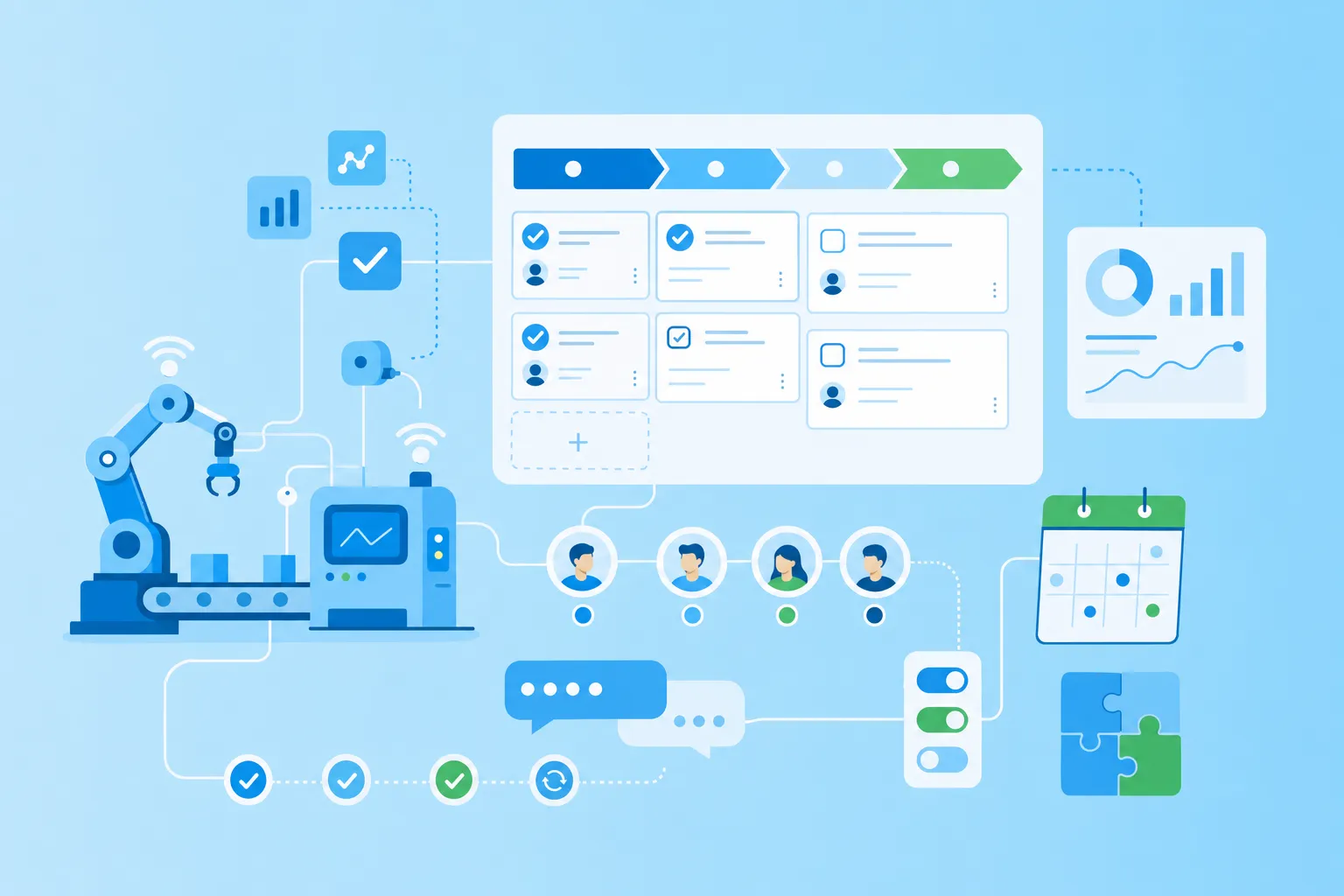
Digital transformation in manufacturing is the shift from manual, paper-based and disconnected production processes to connected, data-driven operations. It covers the shop floor, where machines and sensors start sharing data, and the work around it, from maintenance planning to quality documentation. Industry 4.0 is the name for the technology side of that shift.
For mid-sized manufacturers, the hard part is rarely choosing the technology. It is running the change: deciding what to digitize first, who owns each step and how to keep production running while it happens. That is what this article is about.
What is Industry 4.0?
Industry 4.0 is the fourth industrial revolution, the integration of connected sensors, cloud computing, data analytics, AI and digital twins into manufacturing operations. It lets factories collect real-time data from machines, predict maintenance needs, optimize production schedules and automate quality control.
The concept rests on four technology pillars: connected sensors and machines that generate data, cloud computing that stores and shares it, AI and analytics that turn it into decisions and digital twins that model a process before you change it in the real world. The term itself comes from the German "Industrie 4.0" plan first presented in Hannover in 2011, aimed at helping manufacturers computerize production.
You probably know all of this already. The harder question is not what Industry 4.0 is. It is how a manufacturing team delivers it while production keeps running.
Why is Industry 4.0 a project management problem, not a technology problem?
The sensors work. The software works. What breaks down is the coordination between the departments that have to implement them together. For most mid-sized manufacturers, Industry 4.0 is a question of who owns the rollout, which teams are involved, what the sequence is and how you keep a multi-month initiative on track while the line keeps running.
Research backs this up. A 2023 study of 370 professionals, published in the Journal of Innovation & Knowledge, found that Industry 4.0 components are a strong predictor of project success, alongside the classic factors of cost, time and quality. In practice, the pattern is familiar: many manufacturers run a successful pilot and then struggle to move from concept to execution.
That reframes the whole effort. Treating Industry 4.0 as a managed project, rather than a shopping list of technology, gives your team a few concrete advantages:
A clear owner and timeline. Someone is accountable for the initiative from assessment through rollout, so it does not stall between departments.
A visible sequence. Work happens in a deliberate order instead of everything at once, which keeps the pilot from collapsing under its own scope.
Shared progress. IT, production, quality and maintenance see the same plan, so handoffs do not fall through the cracks.
Managed risk. Skills gaps, budget pressure and security tasks are tracked openly rather than surfacing as surprises.
Why do Industry 4.0 projects stall in mid-sized manufacturers?
Most Industry 4.0 projects in mid-sized manufacturers stall not because of the technology but because of coordination: too many departments involved, no single project owner and no structured way to track progress across a multi-month initiative while production continues. Four failure modes come up again and again.
No single project owner
IT says the initiative belongs to production, because it changes how the line runs. Production says it belongs to IT, because it is about data and systems.
The skills needed to run it are scarce, and without one accountable owner, those specialists get pulled onto whatever is loudest that week.
Too many parallel workstreams
Sensor installation, software integration, data infrastructure, process redesign and staff training all run at the same time. Each team knows its own piece, but no one holds the full picture. When one workstream slips, the teams that depend on it find out too late.
Production cannot stop
Unlike a pure IT project, a manufacturing digitization project must proceed alongside live production. You cannot take the line down for a week to install sensors. Every hour of project work competes with an hour of output, so scheduling conflicts between the initiative and daily production are constant and have to be negotiated openly.
The pilot never scales
A sensor pilot succeeds on one machine, everyone celebrates, and then it stays there. The rollout to the rest of the line never happens because no one wrote the plan to scale it. A promising proof of concept quietly becomes a permanent experiment.
What are the five phases of an Industry 4.0 project?
A typical Industry 4.0 project follows five phases: assessment, pilot, evaluation, rollout and optimization. Running them in order is what turns a good idea into a working line.
Phase 1: Assessment
Start by identifying which production processes stand to gain the most from digitization. Good criteria are how often a step needs manual intervention, what downtime costs when it happens and whether usable data is already available. Prioritize a short list rather than trying to digitize everything, and treat this like the front end of any structured plan. NIST's manufacturing experts make a strong case for starting small and prioritizing high-value processes before you scale.
Phase 2: Pilot
Test on a single machine or production line. Define success criteria before you start: which metric needs to improve, by how much and in what timeframe. Four to eight weeks is a realistic window. Keep a simple log of every adjustment made during the pilot, because those notes become the setup instructions for the rollout. This is where the technology layer, the sensors, and connected equipment get their first real test against production conditions.
Phase 3: Evaluation
Measure the pilot against the criteria you set. Document what worked, what did not and what has to change before you scale. Be honest here, because a pilot that looks fine but misses its target should not advance unchanged. Tracking a few clear project KPIs keeps the evaluation grounded in numbers rather than impressions. Share the results with every department involved, not only the project team, so the people who will run the new setup understand what changed and why.
Phase 4: Rollout
Scale from the pilot to full production. This is where most projects fail, because teams treat the rollout as a formality after a successful pilot. It is not. The rollout plan, timeline and responsibilities need to be as structured as the pilot was, which is the same discipline behind sound manufacturing project management day to day. Before the rollout starts, agree on a go or no-go checkpoint for each group of machines, so problems surface on machine three rather than machine thirty.
Phase 5: Optimization
Once connected, machines are feeding you data; use it to improve continuously. This is where Industry 4.0 meets continuous improvement in manufacturing: the data makes waste visible, and disciplined process work removes it. Optimization is not a final step so much as the point where the initiative becomes part of how the plant runs.
Who should be on the Industry 4.0 project team?
The single biggest predictor of a stalled initiative is unclear ownership, so decide early who is on the team and what each person owns. In a large manufacturer, that can mean a dozen distinct roles: a process engineer, a data analyst, a production manager, a quality engineer, a maintenance lead, a cybersecurity specialist, and IT support, among them. In a mid-sized plant, one person often covers several of these, and that is fine as long as the responsibilities are named rather than assumed.
What matters is that every task has one accountable owner. IT installs the sensor, quality defines what "good" looks like and production validates the data, each as a separate responsibility with a deadline. A RACI matrix is a straightforward way to make ownership explicit before the work starts, so no task falls through the cracks between two departments.
How do you coordinate an Industry 4.0 project in MeisterTask?
MeisterTask is not an IoT platform or an MES, and it does not try to be. It is the coordination layer that keeps every department involved in an Industry 4.0 project working from the same plan, with clear ownership, deadlines and progress everyone can see. Here is how manufacturing teams put it to work.
A board per phase. Set up one board for each phase of the initiative, from assessment to optimization. Tasks move through sections as work progresses, so the whole team can see where every workstream stands at a glance.
Cross-department task ownership. Assign a named owner to each task from the responsible department. That way, no step sits between two departments without a name on it.
Recurring pilot check-ins. Create a weekly recurring task for the pilot review. Task comments capture the metrics, observations and decisions from each meeting, so the full pilot history stays searchable instead of scattered across inboxes.
A rollout checklist per machine. When you scale from pilot to full production, give each machine its own task card with a standard checklist: hardware installed, software configured, data flowing, staff trained, sign-off complete. Nothing gets skipped on machine number 14 because it was done from memory.
Documentation in Notes. Keep technical specifications, integration steps, vendor contacts and lessons learned in Notes, linked to the project board. When the next initiative starts, the knowledge is already there.
Because an Industry 4.0 rollout generates large volumes of sensitive machine and production data, it helps that MeisterTask is ISO 27001 certified, GDPR compliant and hosted in Germany. The coordination layer holding your project together meets the same security bar as the data flowing through it.
How does Industry 4.0 fit with lean manufacturing?
Industry 4.0 and lean manufacturing are complementary, not competing approaches. Lean removes waste through process discipline. Industry 4.0 supplies the real-time data that makes waste visible in the first place.
In practice, lean methods such as 5S, Kaizen and PDCA set the operational standard, and Industry 4.0 technologies provide the measurements to refine it. The same coordination approach manages both: a Kaizen action item and a sensor rollout task can live on the same board, be owned by the same accountable people, and be tracked in the same way.
Turn your manufacturing digital transformation into progress
Industry 4.0 rewards manufacturers who treat it as a coordinated project rather than a technology purchase. The teams that succeed are the ones that name an owner, sequence the work, keep every department on the same page and manage risk in the open, from the first pilot to a fully connected line.
That is where a shared workspace earns its place. MeisterTask keeps an Industry 4.0 initiative organized, transparent and secure, so IT, production, quality and maintenance can move as one team instead of four. Explore MeisterTask for manufacturing and give your next digitization project a home where the plan, the progress and the people all stay in view.