
What is stakeholder analysis?
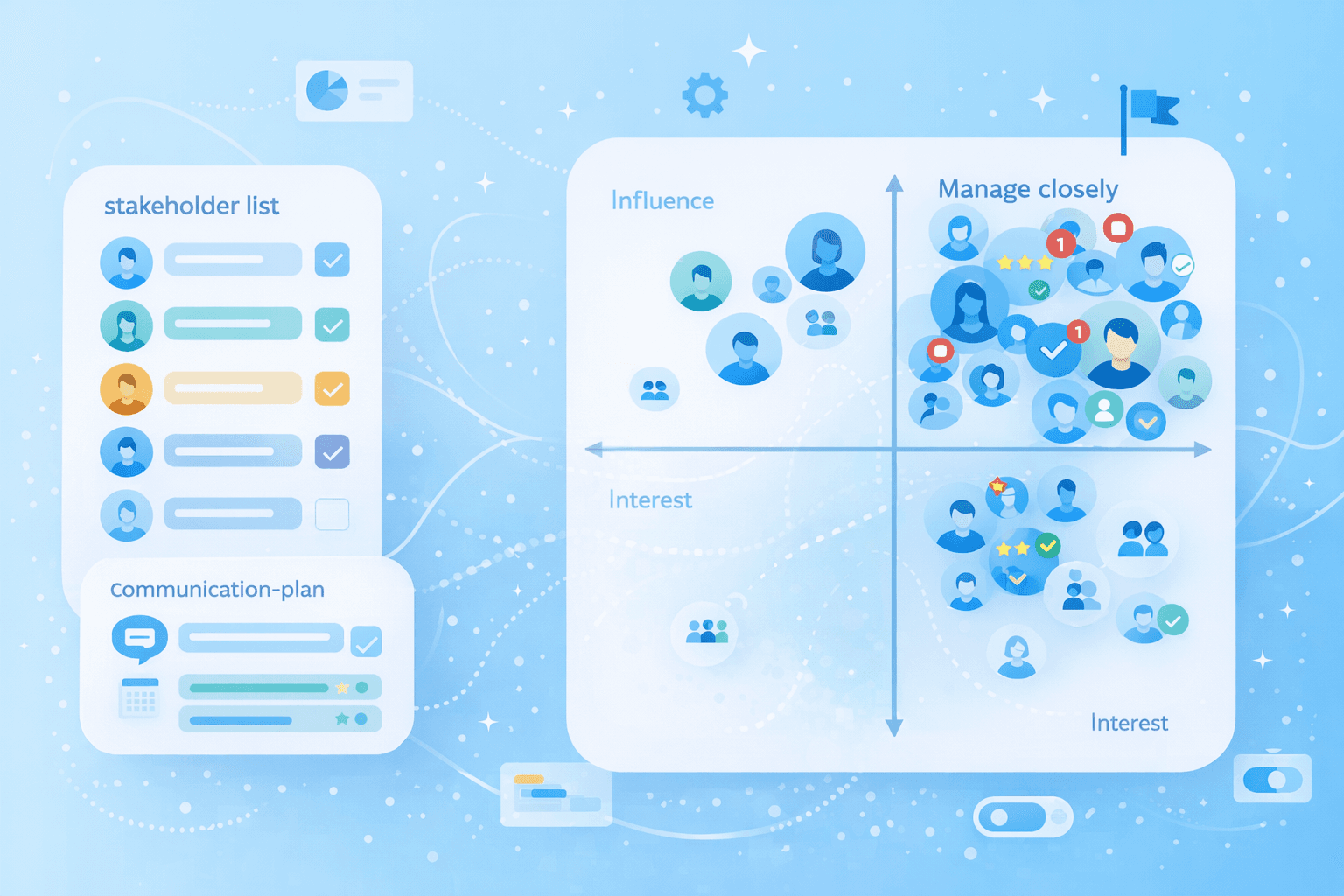
A stakeholder analysis is a way to identify everyone who can affect or be affected by your project, figure out how much influence and interest each person has, and plan how to keep them engaged from start to finish.
So who counts as a stakeholder? Anyone interested in the project outcome. That includes your team members and executives, but also suppliers, regulators and the people who will actually use what you build.
At its core, a stakeholder analysis answers three questions about your project stakeholders:
Who are they?
How much influence do they have?
What do they care about?
Purpose and outcomes
A finished stakeholder analysis gives you three things you can use right away:
A stakeholder list: the names and roles of everyone who matters to the project
An influence-interest map: a visual that shows who to engage closely and who to keep informed
A communication plan: the frequency, format and owner for each stakeholder group
The communication plan is where it gets practical. Instead of a vague "we'll keep people updated," you end up with a schedule showing who gets a weekly call and who gets a monthly email.
Why stakeholder analysis matters for projects
Good stakeholder management directly affects whether your project finishes on time, stays on budget, and gets the support it needs. Three benefits stand out.
Risk reduction
Stakeholder analysis surfaces objections and dependencies early, before they turn into blockers. Picture a manufacturing project that spots the compliance team as a high-influence stakeholder in week one. By the time regulatory sign-off is needed in week eight, the team is already briefed, so the approval takes days rather than weeks.
Faster decision-making
When you know who actually holds decision authority, you avoid bottlenecks and approval loops. If your analysis shows the CFO has final budget authority, you bring financial questions straight to them instead of routing drafts through three departments.
Regulatory compliance
Regulated industries – public sector, finance and manufacturing – often require documented stakeholder engagement for audit trails. A formal stakeholder analysis creates the record auditors look for, with names, roles and engagement history in one place. MeisterTask is ISO 27001-certified and GDPR-compliant, so the documentation remains secure.
Key stakeholder categories you must know
Before you can map anyone, you have to find them. The three pairs below act as a checklist during stakeholder identification, helping you spot people you might miss on a first pass. Keep in mind that these categories overlap – the same person can be internal and primary, for example.
Internal vs external
Internal stakeholders: team members, project sponsors, department heads, IT support, legal, compliance
External stakeholders: clients, suppliers, regulators, industry bodies, community groups
Internal stakeholders are easier to reach, but external ones often control dependencies you can't move without.
Primary vs secondary
Primary stakeholders: directly affected by the outcome – end users, the project team, and budget holders
Secondary stakeholders: indirectly affected – adjacent teams, industry observers
Primary stakeholders need closer, more frequent engagement because their day-to-day work changes when your project ships.
Direct vs indirect
Direct stakeholders: involved in delivery – project manager, developers, designers
Indirect stakeholders: affected by results but not involved in the work – customers, teams whose workflows will change
Indirect stakeholders are easy to overlook during planning, but then become very vocal during rollout.
Step-by-step stakeholder identification process
With the categories in mind, you can move on to the first concrete step in conducting a stakeholder analysis: identification. Each step builds on the last and feeds straight into the mapping exercise that comes next.
1. List potential stakeholders
Start with a quick brainstorm, either solo or with your core team. A few prompts help you cover angles people usually forget:
Who requested this project?
Who will use the deliverable?
Whose budget funds it?
Whose approval is required at each stage?
Who will be affected by the change it introduces?
Who has blocked similar projects before?
Capture names and roles in a simple table or task board so you can sort and update them as the picture sharpens.
2. Validate the list with the team
Share your draft with the project sponsor and one or two people who know the organization well. They'll spot the quietly influential names – an advisor the CEO trusts, a department head with veto power, a compliance officer whose sign-off you didn't know you needed.
3. Capture interests and expectations
For each person on the list, write down what they care about and what they expect. The finance director cares about staying on budget. The operations manager wants no disruption to the production line. The compliance officer expects documented risk assessments.To prevent conflicting expectations from pulling your project off course, ensure they align with your overarching team mission statement. You'll use these notes when you map stakeholders and plan how to talk to them.
Stakeholder mapping with the influence interest matrix
Once your list is solid, you can move into stakeholder mapping. The influence-interest matrix – sometimes called the power-interest matrix – is the most common stakeholder analysis template and the easiest place to start.
The matrix has two axes:
Influence (or power): how much the stakeholder can affect project decisions, resources, or outcomes
Interest: how much they care about the project and its results
Plotting people on the grid shows you exactly how to engage each group.
Quadrant definitions
Each of the four quadrants suggests a different engagement strategy.
Quadrant
Influence
Interest
Engagement strategy
**Manage closely**
High
High
Frequent updates, being involved in decisions, address concerns immediately
**Keep satisfied**
High
Low
Regular briefings, consult before major decisions, don't overload with detail
**Keep informed**
Low
High
Ongoing updates, invite feedback
**Monitor**
Low
Low
Occasional updates, no dedicated effort
Most projects have two to four people in "manage closely," and that's where most of your energy goes.
Real-world example
Imagine a manufacturing company rolling out a new inventory tracking system. Here's how the stakeholders might land:
Manage closely: operations director (depends on the system daily), IT manager (controls implementation resources)
Keep satisfied: CFO (controls budget, low day-to-day interest), plant manager (can block rollout)
Keep informed: warehouse supervisors (use the system daily, no decision authority), procurement team (affected by process changes)
Monitor: external auditor (reviews once a year), industry association (general interest)
Notice the operations director and IT manager both sit in "manage closely" – they get weekly check-ins. The CFO gets a monthly summary unless the budget is at risk.
Prioritizing stakeholders with the salience model
The influence-interest matrix works for most projects, but sometimes stakeholder politics are too tangled to fit on two axes. That's where the salience model helps. Developed by researchers Mitchell, Agle and Wood, the model ranks stakeholders by three attributes instead of two.
Power attribute
Power is the ability to impose one's will on the project through authority, control of resources, or influence over decision-makers. A budget holder has power. So does a department head whose team has to adopt the deliverable.
Legitimacy attribute
Legitimacy means that a stakeholder has a socially accepted or appropriate claim to the project. End users have legitimacy because the project is built to serve them. A regulator has legitimacy because they enforce rules your organization has agreed to follow.
Urgency attribute
Urgency means the claim needs attention now – a deadline, a risk, or a consequence is attached. A client with a contract deadline has urgency. So does a compliance officer flagging a legal issue. Urgency can shift mid-project, too, when a new regulation lands or a competitor ships first.
Stakeholders with all three attributes – power, legitimacy, and urgency – are your top priority. Those with two still need close attention. Those with one can usually be monitored. Reach for the salience model when the influence-interest matrix feels too simple for the politics in play.
Building a stakeholder management plan
Mapping is only useful if it leads to action. A stakeholder management plan spells out who talks to each stakeholder, how often, and through what channel – turning your matrix into something your team can act on.
Choose communication channels
Different stakeholders prefer different formats based on their quadrant and personal style:
High influence, high interest: video calls, dedicated chat channels, early access to documentation
High influence, low interest: monthly summary emails, dashboard links, escalation protocols
Low influence, high interest: project newsletters, shared Notes in MeisterTask, open office hours
Low influence, low interest: quarterly updates, public project pages
Match the channel to the person – some executives prefer a two-slide deck, others want a live walk-through.
Set frequency and responsibility
Next, decide how often each group hears from you and assign an owner so the responsibility doesn't drift.
Stakeholder
Quadrant
Frequency
Format
Owner
Operations director
Manage closely
Weekly
Video call
Project manager
CFO
Keep satisfied
Monthly
Email summary
Project sponsor
Warehouse supervisors
Keep informed
Biweekly
Update in Notes
Team lead
External auditor
Monitor
Quarterly
Email update
Compliance lead
Document the plan in your project board so everyone knows who owns each relationship.
Track actions in a task board
Stakeholder conversations always produce follow-ups – questions to answer, concerns to address, approvals to chase. A dedicated section in MeisterTask keeps these visible. A task like "Address CFO budget concern," with a due date, owner and link to the meeting notes, turns a corridor chat into a tracked commitment.
Common pitfalls and how to avoid them
Even teams that conduct a careful stakeholder analysis still make a few predictable mistakes. Three come up most often.
Overlooking quiet influencers
People who don't attend meetings or speak up can still derail a project if they have the CEO's ear or control a critical dependency. During identification, ask directly: "Who influences the decision-makers?" and "Who has blocked projects before?" The answers usually surface names your first list missed.
Relying on one-off assessments
Influence and interest shift as a project moves forward. A low-interest sponsor can become highly engaged when a risk emerges. A supportive department head can lose pull after a restructure. Schedule a stakeholder review at each milestone or phase gate and update your matrix – a 15-minute refresh beats discovering at week 12 that your main contact no longer has the authority you assumed.
Storing sensitive data insecurely
Stakeholder analyses often hold sensitive notes on politics, concerns, and influence. That information doesn't belong in a public spreadsheet or a personal inbox. Use a work management platform with role-based access and encryption. MeisterTask is ISO 27001-certified, GDPR-compliant, and hosted in Germany – important for public sector and finance teams, where a leak isn't just awkward - it's a breach.
Stakeholder analysis template you can use today
Theory only gets you so far. A ready-made stakeholder analysis template lets you start your own analysis this afternoon, with both a matrix worksheet and a MeisterTask board.
Download the influence interest matrix
The matrix template is a four-quadrant grid with influence on the Y-axis and interest on the X-axis. Each quadrant has space for stakeholder names and roles, plus a notes column for communication preferences and key concerns. Print it for a workshop or fill it in digitally. [download the stakeholder analysis template]
Copy the MeisterTask board
The MeisterTask board turns your analysis into a working project. The structure includes:
Section 1: Stakeholder list – tasks for each stakeholder, with custom fields for influence, interest and quadrant
Section 2: Communication plan – recurring tasks for scheduled updates
Section 3: Actions and follow-ups – tasks from stakeholder conversations, linked to the right person
Section 4: Review and update – milestone tasks to revisit the analysis at phase gates
Copy the board, customize it for your project and invite your team.
Keeping your analysis up to date
A stakeholder analysis isn't a one-time exercise – it's a living document. A few light-touch habits keep it accurate without adding much work.
Review triggers
Certain events are a signal that your matrix may be out of date:
Major milestone completion
Scope or timeline changes
Budget revisions
Leadership changes or restructures
Escalations or unexpected objections
Set a recurring task in MeisterTask to review the matrix monthly, even when nothing's changed.
Lessons learned integration
At project retrospectives, capture what worked and what didn't in stakeholder engagement. A few prompts help: Did we identify the right people early enough? Were any quadrant placements wrong? Did communication frequency match what each group needed? Store the answers in Notes in MeisterTask so the next project manager starts with your experience, not a blank page.
Secure collaboration in MeisterTask
A good stakeholder analysis is rarely a solo job. It depends on the project manager, sponsor and core team working closely together – which means you need a secure, central place to do that work. MeisterTask brings the pieces into one place:
Centralized stakeholder data: all analysis, plans and follow-ups in one board
Role-based access: control who sees sensitive notes
Task tracking: every stakeholder action has an owner and due date
Integration with Notes: link analysis to meeting notes and project documentation
ISO 27001 and GDPR compliance: meets requirements for public sector, finance and manufacturing teams
The result is an analysis that lives where the work happens, with the access controls and audit trail that regulated industries expect.