
What is a feasibility study?
A feasibility study is a structured assessment of whether a proposed project is worth pursuing before the organization commits budget, time and people. It answers one question: should we do this, and if so, under what conditions?
A feasibility study sits early. It usually comes before you write the project proposal, before anyone signs a project charter and long before project planning begins. When done well, it saves money by killing weak ideas before they consume resources, and it confirms strong ideas with evidence rather than enthusiasm.
It helps to separate three things that often get blurred. A business case argues for the project. A project plan details how the project will be executed. A feasibility study does neither. It stays neutral, and its job is to find the truth rather than justify a decision someone already wants to make.
The five types of feasibility analysis
Most feasibility studies examine up to five dimensions. Each one asks a different question, and each one can stop a project on its own.
Technical feasibility
Technical feasibility asks whether you can build the thing with the technology, skills and infrastructure you have or can reasonably acquire. It looks at tools, systems and capacity, not just ambition. For example, does your team have the engineering capacity to build a custom integration in-house, or would you need to hire someone to do it?
Operational feasibility
Operational feasibility asks whether you can run the project once it is built and whether it fits how your teams already work.
For example, if you launch a self-service customer portal, can your support team handle the added ticket volume it creates?
Financial feasibility
Financial feasibility assesses whether you can afford the project and whether it will generate sufficient value to justify the investment. It covers direct costs, opportunity costs and expected returns. For example, an $80K project that saves $30K a year has a payback period of about 2.7 years, so the real question becomes whether that timeline is acceptable to your organization.
Schedule feasibility
Schedule feasibility asks whether you can deliver within the required timeframe, given everything else your teams are already committed to. Time is a constraint, not an afterthought. For example, if the launch date is fixed for September, is it realistic to finish development, testing, and training by then?
Legal and regulatory feasibility
Legal and regulatory feasibility asks whether compliance, regulatory or contractual barriers stand in the way. These issues rarely appear until someone looks for them, and by then, they are expensive. For example, does processing customer data as you intend require explicit GDPR consent that you do not currently obtain?
You may also see the term "market feasibility." Some frameworks fold it into financial or operational feasibility, while others treat it as a separate dimension, so if you searched for it, you have not missed a category so much as a different way of grouping the same questions.
How to conduct a feasibility study, step by step
A feasibility study follows a repeatable sequence. These six steps take you from a vague idea to a recommendation that leadership can act on.
1. Define what you are evaluating
Start by stating the proposed project in a single sentence: what it delivers, for whom and by when. A tight definition prevents scope creep inside the evaluation itself. If you cannot describe the project in one sentence, you are not ready to assess it.
2. Identify the evaluation criteria
Decide which of the five feasibility types applies to this specific project. Not every project needs all five. A small internal process change may require only financial and operational feasibility, while a customer-facing product launch likely requires all three. If the team struggles to agree on the criteria, sketch them as branches in a MindMeister mind map first, so everyone sees the full picture before the research starts.
3. Gather evidence
Assign specific research tasks, each with a named owner and a deadline. Evidence does not gather itself, and vague ownership is how studies stall. This is where MeisterTask helps: create a feasibility study project with one task per research area, assigned to the person with the relevant expertise.
With owners and due dates in place, the study moves at a predictable pace instead of drifting. Each finding lands in one place, attached to the task that produced it, so nothing gets lost in email threads. Identify who has influence early, too: APM guidance on stakeholder engagement recommends analyzing each stakeholder's interest and their relative power to change how things are done. Gather input from influential people openly and weigh it against the evidence to keep the study neutral.
4. Assess each dimension
Document your findings and rate each dimension high, medium or low. Be honest about the ratings, because their whole purpose is to surface problems early. A single low rating in a critical dimension, usually financial or technical, is often enough on its own to recommend not proceeding.
5. Identify conditions and risks
Even a "go" recommendation carries conditions. Document what must be true for the project to succeed and what risks remain if it goes ahead. A simple project risk matrix helps you rank each risk by likelihood and impact, so leadership sees which ones deserve attention.
6. Write the recommendation
Close with a single paragraph: go, no-go, or go with conditions, supported by the evidence you gathered. This is the part leadership reads first, so make it clear and specific. According to Oxford professor emeritus Bent Flyvbjerg's research on more than 16,000 projects, only about 8.5% of projects hit both their cost and time targets, evidence that projects tend to "start wrong" more than they go wrong. Disciplined upfront evaluation is how you avoid starting wrong.
Three feasibility study examples
The dimensions make more sense with real decisions attached to them. Here are three short scenarios that show how a study reaches its recommendation.
Example 1: a new product feature
A product team evaluates adding an AI-powered search to its app. Technically, it is feasible: the team has the machine learning expertise, but needs about six months. Financially, the project costs $120K against a projected $200K annual revenue uplift; operationally, the support team needs training, and on schedule, it cannot ship before Q2. Legally, the way search processes user data needs a GDPR review. The recommendation is to go with the conditions: hire one machine learning contractor and complete the GDPR review before development starts.
Example 2: an office relocation
An operations team evaluates moving to a larger office. Technically, it requires an IT rebuild, and financially, it means a $250K one-time cost against $40K in annual savings. Operationally, the team expects about two weeks of reduced productivity during the move. On schedule, the current lease expires in six months, which is feasible only if the decision is made within four weeks. The new lease has been reviewed and holds no legal barriers. The recommendation is to proceed with lease negotiation.
Example 3: process automation
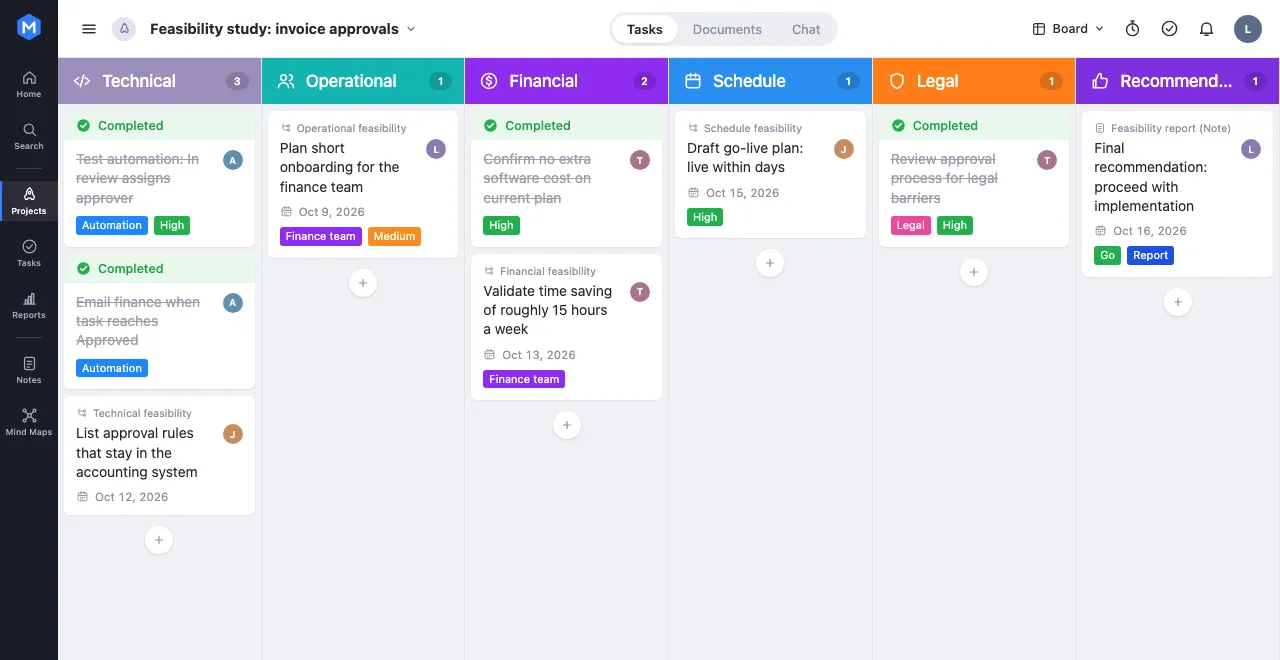
An operations team is evaluating the automation of invoice approvals. Technically, automations in MeisterTask can support this: when an invoice task is moved to the In review section, the approver is automatically assigned, and when it reaches Approved, finance receives an email notification. Complex approval rules would still need the accounting system. Financially, it adds no software cost, as the team already uses a paid plan, and it estimates it will save roughly 15 hours a week. Operationally, the finance team expects a short onboarding period; on schedule, it can go live within days, with no legal barriers. The recommendation is to proceed with implementation.
What a feasibility report should include
Whatever the size of the project, a good feasibility report covers the same core elements. Keep each one short and evidence-based so the reader can follow the logic from question to recommendation.
Project description: what the project delivers, for whom and by when, in one or two sentences.
Scope of the study: which feasibility dimensions you assessed and why any were left out.
Findings per dimension: the evidence for each dimension, with a high, medium or low rating.
Alternatives considered: other ways to reach the same goal, including doing nothing, and why they were ruled in or out.
Conditions and risks: what must be true for the project to succeed and which risks remain.
Recommendation: go, no-go or go with conditions, stated in the first lines of the report.
If a section feels thin, that usually signals missing evidence rather than a writing problem. Go back to the research tasks before you finalize the recommendation.
Feasibility study template
Use the template below as a starting point. Copy it, replace the bracketed placeholders and keep it to a length that matches the size of the decision.
Feasibility study Project/initiative name: [Project/initiative name] Date: [Date] Author: [Author] Sponsor/requestor: [Sponsor/requestor]
Project description: [one to two sentences]
Feasibility assessment Technical feasibility: [high/medium/low], [one-line finding] Operational feasibility: [high/medium/low], [one-line finding] Financial feasibility: [high/medium/low], [cost, expected return, payback period] Schedule feasibility: [high/medium/low], [one-line finding] Legal feasibility: [high/medium/low], [one-line finding]
Key risks:
[risk 1]
[risk 2]
[risk 3]
Conditions for success:
[condition 1]
[condition 2]
[condition 3]
Recommendation: [go / no-go / go with conditions]
Rationale: [one paragraph]
Running this process in MeisterTask keeps the whole study in one place. Set up a project with one section per feasibility dimension, add research tasks with deadlines assigned to the right people, use task comments to document findings as they come in and draft the final report in Notes, linked to the relevant tasks. The recommendation section works as a one-paragraph executive summary, so the person approving the project can read the decision first and the details second.
Common feasibility study mistakes
A few predictable errors undermine otherwise solid studies. Watch for these.
Confirmation bias: the study is run to justify a decision someone has already made. To keep it honest, the person who proposed the project should not be the one who runs the study.
Skipping the financial analysis: everything looks feasible until you calculate the cost. Always include financial feasibility, even for small projects where the numbers seem obvious.
No clear recommendation: the study documents findings but never states go or no-go.
Overcomplicating it: a feasibility study for a $50K project should not take three months. Scale the depth of the study to the size of the decision.
Turn evidence into action with MeisterTask
A feasibility study turns opinion into an evidence-based go/no-go decision. It is the gate that determines whether a project plan exists at all, which is why discipline matters more than format. When you assess technical, operational, financial, schedule and legal feasibility honestly, you stop good projects from being killed by doubt and stop weak ones from draining your budget.
MeisterTask gives that process a home. Research tasks stay organized and assigned, progress stays transparent to everyone involved and findings live in Notes, linked to the tasks where the work happens. Because MeisterTask is ISO 27001 certified, GDPR compliant and hosted in Germany, sensitive project data stays protected while your team makes the call. Assess the evidence, make the decision with confidence and move the projects that deserve to move.